G. Prevost
Active in 1701
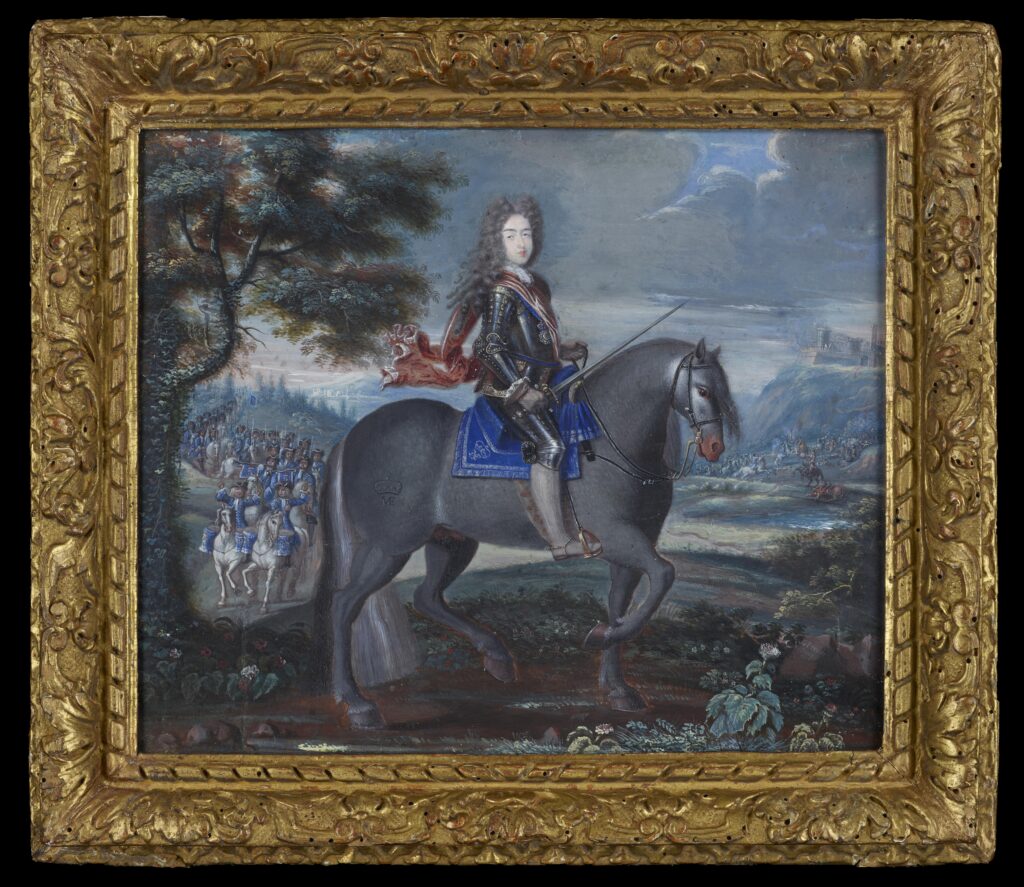
An equestrian portrait of Maximilian II Emanuel (1662-1726), prince-elector of Bavaria
Medium:
Gouache on Paper laid down on Panel
Category:
Dimensions:
22(h) x 25(w) cms
Framed Dimensions:
27.5(h) x 32(w) cms
Signed:
Signed and dated bottom right: 'G. Prévost / pinxit / 1701'
Essay:
Little seems to be known about the artist G. Prevost (or Preuost). He was likely of Flemish or French origins and appears to have specialised in landscapes in the historical mode in gouache rather than oil. No other works by him are recorded and it is hoped that more information on this talented artist will soon come to light.
-
This heroic equestrian portrait depicts Maximilian II Emanuel, prince-elector of Bavaria. Represented in the iconic trope of the mounted military commander, Maximilian is seen proudly leading his blue uniformed soldiers towards an enemy fort in the distance. Two royal monograms ME and EMB (Maximilian Emanuel / of Bavaria) topped by a crown are emblazoned on his saddle and his horse's flank. The date of this picture, 1701, was a crucial one for Maximilian. It was the year that he made a grand play for power seeking to topple one of European's greatest dynasties and replace it with his own House of Wittelsbach.
Maximilian became the prince-elector of Bavaria in 1679. He was born in Munich to Ferdinand Maria, Elector of Bavaria (1651 - 1679) and Princess Henriette Adelaide of Savoy (1651 - 1676). They prepared their son for greatness by modernising Bavaria's army and rebuilding the treasury and much infrastructure which had been lost during the Thirty Years' War.
Known as an able soldier with grand ambitions, Maximilian cut his teeth as a commander when he personally led 11,000 troops to Austria's aid at the Battle of Vienna against the Ottomans in 1683. Successfully liberating the city, Maximilian was rewarded by marrying Maria Antonia of Austria (1669 - 1692), thus edging his dynasty to within touching distance of the Spanish throne to which, through a complicated family line, Maria Antonia had a strong claim. In 1688 Maximilian again proved himself a brave leader when he led the capture of Belgrade, fighting in the front lines, and earning the moniker "The Blue King" for his distinctive uniform.
Having fought once more for the Hapsburgs against Bourbon France in the War of the Grand Alliance, at the end of 1691 he was appointed Governor of the Spanish Netherlands. This was an exceptionally lucrative and powerful position which further advanced his claim to the Spanish crown. However, his ambitions were curbed by the death of both his wife and son in quick succession during the 1690s.
In 1701 the War of the Spanish Succession saw Maximilian side with the French against Holy Roman Emperor Leopold I, his former father-in-law. Philip of Anjou, grandson of Louis XIV of France, had been promised the Spanish throne, and by allying himself with the French, Maximilian hoped to share the Spanish Hapsburg territory and even supplant the Austrian Hapsburg family with his own. However, any such designs he may have had ended in catastrophic defeat at the Battle of Blenheim in 1704. Losing control of Bavaria, Maximilian fled to the Spanish Netherlands to continue the war. In 1714 he was eventually able to return to Bavaria with his territory intact, but his political aspirations thwarted.
During his life Maximilian had been a great patron of the arts. He acquired many paintings while governor of the Spanish Netherlands, notably 101 mainly Flemish paintings from the Antwerp merchant Gisbert van Colen. These included several works by Rubens, Brouwer and van Dyck. In 1701 he began the construction of the New Palace of Schleißheim near Munich, which was intended to house his extensive art collection. Much of this collection is today housed in the Alte Pinakothek, Munich.
Provenance:
Private collection, France.