Jan Brueghel the Younger
1601 - 1678
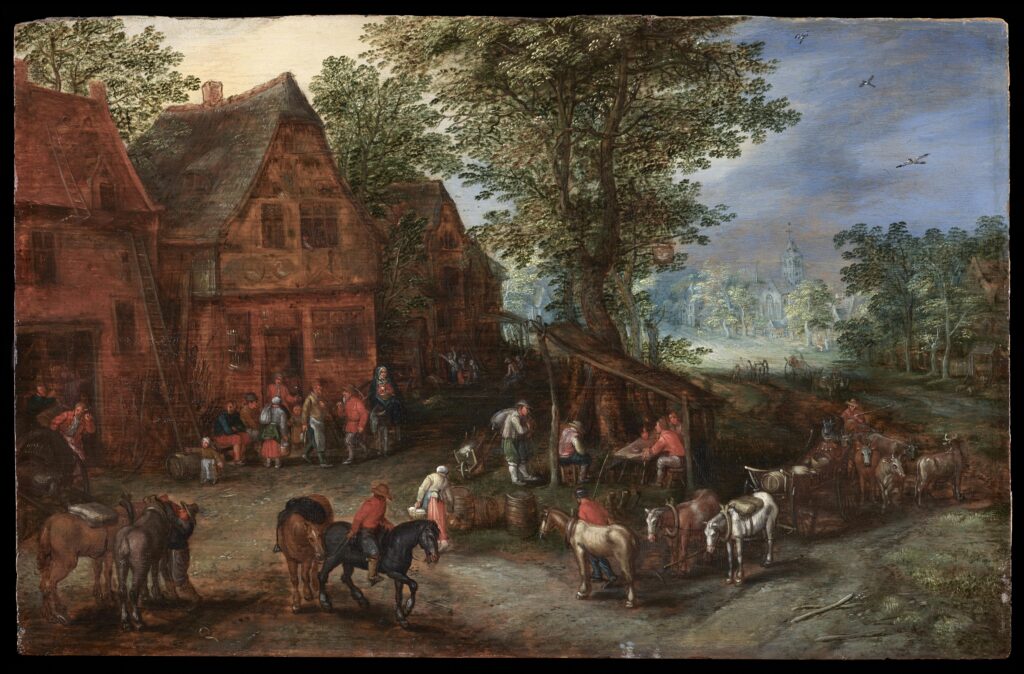
A Village with Travellers halting at an Inn
Essay:
Jan Brueghel the Younger began his career as a pupil of his famous father Jan Brueghel the Elder. From 1622 he travelled extensively in Italy, where he was to meet Sir Anthony van Dyck and Lucas de Wael. Here he also made the acquaintance of Archbishop Borromeo who had been his father's important patron.
He returned to Antwerp after the death of his father in 1625. This same year he was to take over his father's workshop and he was also elected a member of the Guild around that time and became the dean in 1630. He married in 1626 and was to have eleven children, five of whom became well known artists (the best known being Abraham and Jan-Baptiste). Apart from occasionally travelling to Paris in the 1650s he remained in Antwerp for the rest of his life.
Jan Brueghel the Younger was to collaborate on other works by his contemporaries including Peter Paul Rubens, Gonzales Coques, Jan van Kessel I (a student of his) and Hendrick van Balen as well as his father. His work is often mistaken for that of his father. Brueghel the Younger is known to have been a very slow and meticulous painter, nevertheless his execution is somewhat looser by comparison and his compositions not as tightly drawn.
-
This peaceful village scene is a previously unknown copy of a painting by Jan Brueghel the Elder sold a Sotheby's, London, 7 July 2010, lot 13 (£1,600,000). The Sotheby's version is the same size as the present picture, dated 1607, painted on copper, and was once in the collection of Elector Max Emanuel of Bavaria (1662-1726) (K. Ertz, Jan Brueghel der Ältere (1568-1625): Kritischer Katalog der Gemälde, Lingen, 2008-10, vol. 2, p. 496, no. 223, reproduced).
Ertz sees the Sotheby's version as the development of a picture dated c.1605 sharing a Bibilcal scene with Joseph and Mary prominent in the foreground being turned away by the inn-keeper (see Ertz, vol. 2, p. 494, no. 222). In both the present picture and the Sotheby's version Joseph and Mary have been pushed further back into the composition, thus diminishing the religious theme of the painting. Ertz also points out a fourth version of the Sotheby's picture in a private collection in Germany (see Ertz, vol 2, p. 498, no. 224).
While the Sotheby's and German versions are nearly identical the present painting deviates from them in several small details : the absence of ground fowl and pigeons; two additional barrels next to the maid in the centre foreground; several abandoned planks of wood in the right foreground.
All of these compositions originate from Brueghel's secular Flemish village scenes painted around 1603-5. These typically depict a village from an elevated viewpoint with carts, villagers and livestock, and a track leading the eye into the distance where a windmill or church steeple can often be spied through the trees.
Provenance:
Hortense Augusta Strettel née Levien (1868 - 1951);
Thence by descent in a private UK collection until 2025;
Private collection, UK.