Francois Duchatel
c.1620 - c.1690
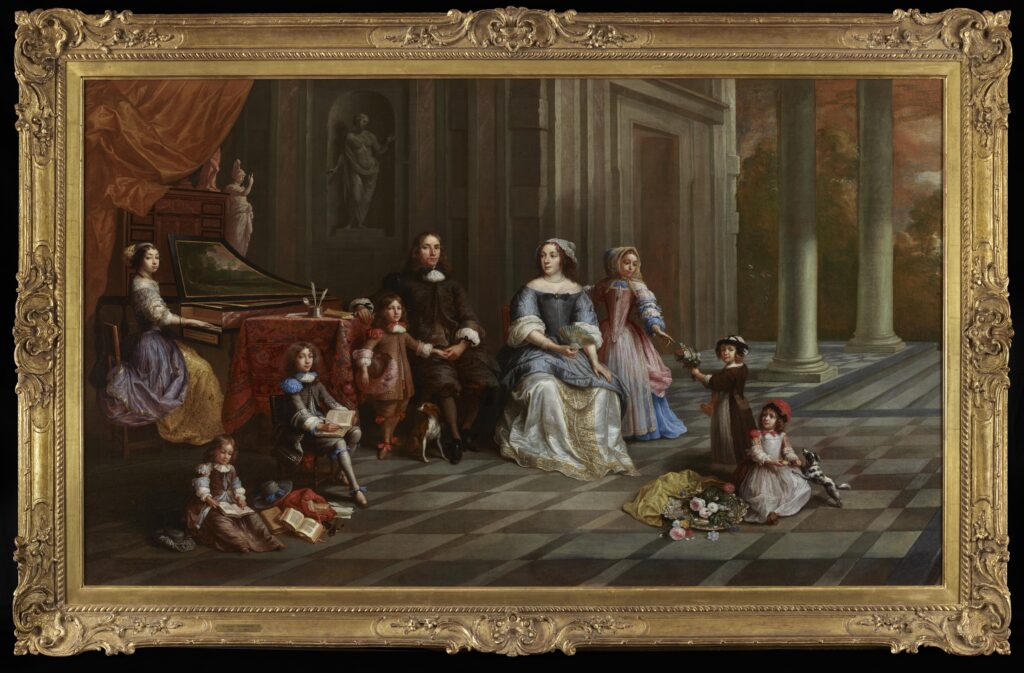
A Family Portrait Group seated in an elegant Architectural Setting
Medium:
Oil on Canvas
Category:
Dimensions:
104(h) x 179.5(w) cms
Framed Dimensions:
127(h) x 197(w) cms
Essay:
François Duchatel was a Flemish painter born in Brussels c.1620. Relatively little is known about his life. A commonly told legend is that his first profession was as a soldier which he gave up upon seeing his best friend killed in battle. It was long speculated that he was a pupil of David Teniers the Younger, and while his style has been often compared to Teniers there does not appear to be any evidence to corroborate this. It is established that he was a pupil of Gaspar de Crayer and there is a contract between them from 1654 where they agree to paint a religious piece together for Averbode Abbey in Brabant.
Duchatel was a versatile artist who worked in many genres from portraits, historical events, and cityscapes, to battle scenes and genre paintings, though today there is a relatively small body of work ascribed to him. It has been speculated that Duchatel travelled to Paris where he worked in the studio of Adam Frans van der Meulen, a court painter who received commissions for the French royal palaces. Duchatel’s most celebrated work is an impressive composition entitled The Inauguration of the Spanish King Charles II as Count of Flanders in 1666 in the Museum of Fine Arts, Ghent (inv. no. S-11) which was commissioned by the Council of Brabant in 1676.
-
Connected in a sinuous line by hands and glances, the sitters in this portrait are resplendent in their fine clothes surrounded by baroque architecture and furniture with all the accoutrements of a wealthy, highly educated family. Classical statues sit behind the elegant harpsichord which one of the elder daughters plays, her neck and wrists adorned with pearls. On the table by the father sits a notebook with two quills and a magnifying glass in a pot. Books abound in the picture with two of the youngest children writing and reading. Education and intelligence was clearly as important as elegance to the family.
It has been speculated that the ‘Janssens’ name traditionally linked to the family in this painting could refer to the artist Victor-Honoré Janssens (1658 – 1736). This supposition derives from Guillaume Pierre Mensaert (1711 – 1777), a pupil of Janssens, who in 1763 published a guide to art in the Austrian Netherlands which states that Duchatel’s son married the daughter of Janssens (see C.P. Mensaert, Le Peintre Amateur et Curieux, Brussels, 1763, p. 52). However, as Janssens would have been 14 years old at the time the picture was painted in 1672, it would appear impossible that the extensive family could belong to him. Likewise, it seems unlikely that he might be one of the sons presented in the painting as Janssens’ own father was a tailor while the family in Duchatel’s portrait is clearly wealthy and probably aristocratic. For now the identity of the family remains unknown.
The 1935 Brussels exhibition catalogue states that the artwork was in the collection of G. (presumably Gaston) de Meester de Heyndonck (1877 – 1939) at Chateau d’Attre near the town of Ath in south west Belgium. It previously belonged to his father Anatole de Meester de Heyndonck (1843-1925) and, according to the Brussels catalogue, had been in the possession of relatives of the Janssens family for several generations.
Chateau d’Attre was rebuilt in 1752 by Count François Philippe Franeau d’Hyon van Gomegnies and was seized from his son in 1794 by the French revolutionary government and sold. It passed to the Val de Beaulieu family in 1814 and came to the Meester family in the second half of the 19th century. It is presumably the Meester family which the Brussels catalogue refers to as being relatives of the Janssens, but so far no connection between these families has been found.
Provenance:
Anatole de Meester de Heyndonck (1843-1925), Chateau d’Attre, Belgium;
Thence by descent to the previous owners.
Literature:
Exposition Internationale de Cinq Siècles d’Art, exh. cat., Brussels, 1935, p. 116, cat. no. 270.
F.-C. Legrand, Les Peintres Flamands de Genre au XVIIe Siècle, Brussels 1963, pp. 101, 109, 278, fig. 44.
A. P. de Mirimonde, 'Les sujets de musique chez Gonzales Coques et ses émules', in Bulletin. Musées Royaux des Beaux-Arts de Belgique. Koninklijke Musea voor Schone Kunsten van België, vol. XVI, Brussels, 1967, pp. 200–201, fig. 28.
A. P. de Mirimonde, 'Scènes de genre musicales de l‘École française au XVIIIe siècle, dans les collections nationales', in La Revue du Louvre et des Musées de France, vol. XVIII, no. 1, Paris 1968, p. 18, mentioned under note 15.
A. P. de Mirimonde, L’Iconographie Musicale sous les Rois Bourbons, Paris 1977, p. 95.
Exhibitions:
Brussels, Exposition Internationale de Cinq Siècles d’Art, 24 May – 13 Oct. 1935, cat. no. 270.