Jan Maurits Quinkhard
1688 - 1772
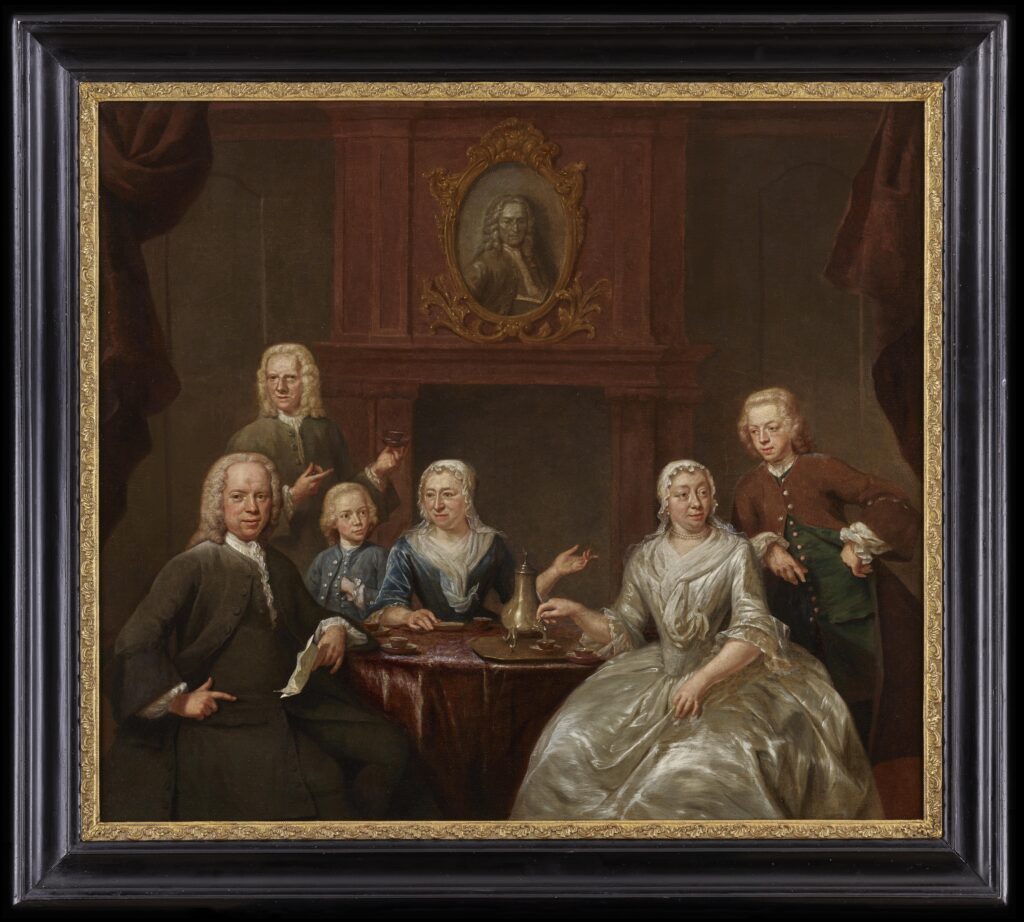
A Conversation Piece with a Family seated at a Table with a Coffee Service, a Portrait of a Gentleman over the Mantelpiece
Medium:
Oil on Canvas
Category:
Dimensions:
78(h) x 89.5(w) cms
Framed Dimensions:
94(h) x 106(w) cms
Signed:
Signed and dated over the mantelpiece: 'J M Quinkhard pinxit 174*'
Essay:
Jan Maurits Quinkhard was the son and pupil of the painter Julius Quinkhard I. By 1710 he was living and working in Amsterdam, where he was taught by Christoffel Lubieniecki (1659–1729), Nicolaas Verkolje (1673–1746) and Arnold Boonen (1669–1729), all leading artists of the period. In addition to producing paintings, drawings, miniatures and designs for prints and engravings, he restored paintings and dealt in art.
Notably Quinkhard contributed to the highly ambitious project The Panpoëticon Batavûm an eighteenth-century cabinet that housed the portraits 'en grisaille' of over 300 Dutch writers and poets. The remarkable collection was started by the Amsterdam painter Arnoud van Halen (1673–1732) around the beginning of the century and after his death passed into the hands of the wealthy Amsterdam broker Michiel de Roode (1685 - 1771). Quinkhard added 21 replacements and 92 new portraits, many of which are now housed in the Rijksmuseum including a portrait of Constantijn Huygens.
-
An elegant family has gathered in their drawing-room for a coffee party. Each hand gesture, pose and piece of clothing has been carefully chosen by the family and drawn by Quinkhard to present the group as fashionable and genteel. The two boys in particular, with hand on hip or tucked into waistcoat, follows models set down in the grandest portraits around Europe.
For their coffee they are using a pear-shaped silver samovar equipped with a spigot which the woman in white, presumably the mother of the two children and mistress of the household, turns to fill a tiny cup. The collision of different worlds is worth noting with south American coffee, a Kraantjeskan (a coffee urn inspired by Russian samovars), and Chinese porcelain cups, all together in a Dutch household - a testament to the globe-spanning nature of Dutch trade.
Another conversation piece by Quinkhard with a family in a similar interior setting using a nearly identical coffee service is dated 1746 (private collection; RKD 97869) and provides useful context for our picture which was painted around the same time. In the 1746 picture the family have a portrait of William IV Prince of Orange over their mantelpiece. From this we can infer that the portrait within the present picture likely represents another notable Dutch figure, presumably a writer or theologian as the man appears to be reading a book. Indeed, this portrait may have some link to Quinkhard's involvement in The Panpoëticon Batavûm.
Provenance:
Anon. sale: Christie's, Amsterdam; The Dutch Interior Including Miniature Works of Art, 15 Oct. 2003, lot 676;
Private collection, UK.