Simon de Vlieger
c. 1600 - 1653
A Dutch Man-o-War under full Sail
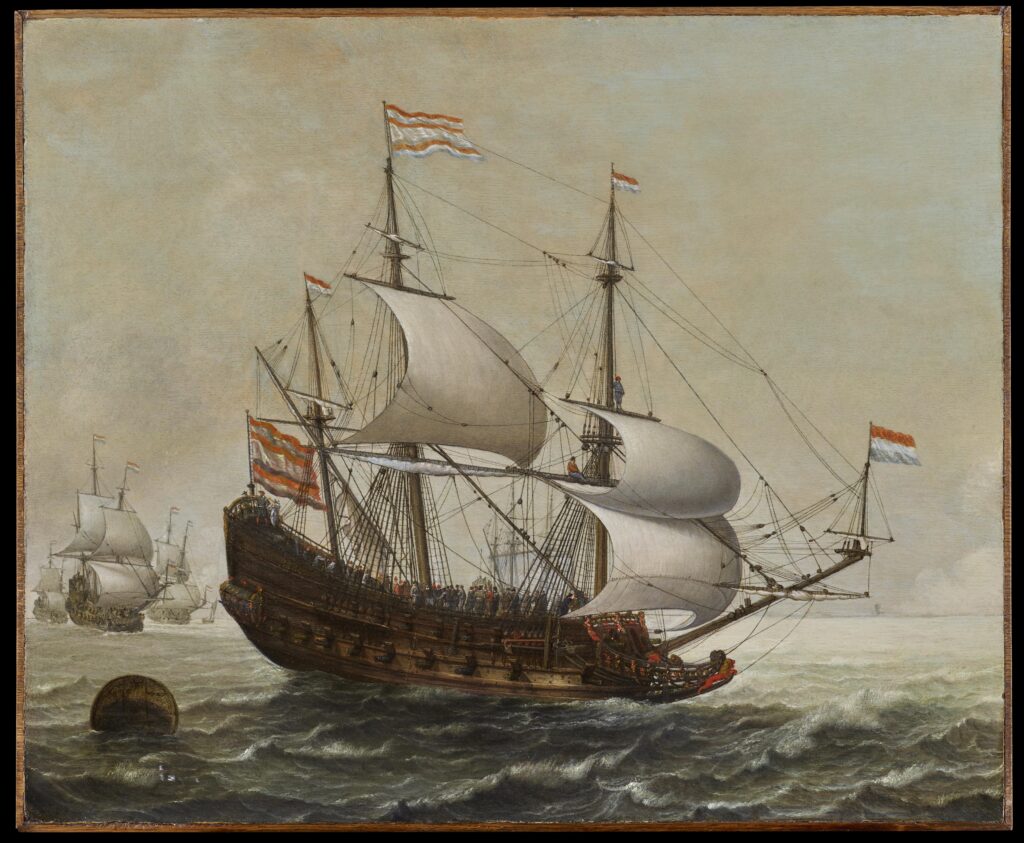
Medium:
Oil on Panel
Category:
Dimensions:
60(h) x 71(w) cms
Signed:
Signed and dated 'S De Vlieger 1627' on the buoy lower left
Essay:
Simon de Vlieger was likely born in Rotterdam. It is unknown who his master was, but he was quite possibly a student of Jan Porcellis. De Vlieger is best remembered as an artist who bridged the gap between the early tonalist sea painters like Porcellis and the next generation of brighter more colourful work of artists like Willem van de Velde. In his earliest paintings he adopted Porcellis' "grey" style of sea-painting but enriched and diversified it with strong contrasts of light and larger quantities of shipping of different types. The fantastic rocks looming out of a rough sea with ships in danger belong to his early period and recall Andries van Eertvelt and Hendrik Vroom.
In his best years he painted a calm or slightly ruffled sea with fishing-boats skilfully executed. The beach with jetties and landing-stages is depicted in detail and often forms a repoussoir enhancing the effect of distance. The fully manned rowing-boats and frigates form a transition to similar themes in the work of Jan van de Cappelle and Aelbert Cuyp. De Vlieger's beach and dune pictures of the 1640's are characterised by the positioning of figures in groups extending well into the background. The perspective thus gained, together with intensified light effects, gives a convincing impression of the infinite remoteness of the horizon.
His later works include commissioned pictures of historical events (sea battles, landings and embarkations). He also occasionally painted forest landscapes with huntsmen or travellers, in the manner of Jacob van Ruisdael and his pupils from Haarlem. His rarer genre scenes and portraits demonstrate his versatile and prolific talent in these fields. His major pupils were Willem van de Velde II and Jan van de Cappelle, who reputedly owned 1300 drawings and nine paintings by de Vlieger.
-
With a single warship dominating the composition at the head of a squadron, in this painting Simon de Vlieger celebrates the tremendous power and spectacle of the Dutch navy. Dated 1627 this picture was made during final phase of the Eighty Years' War when de Vlieger would have been around 27 years old. The navy was the great pride and bulwark of the fledgling Dutch Republic which had been in and out of war with Hapsburg Spain for so many years (and many more years to come). Like all Dutch Man-o-Wars the foreground ship displays a roaring red lion figurehead (also known as States Lion).
This picture was painted towards the start of de Vlieger's career with the earliest known work by him dated to 1624. In January of 1627 de Vlieger's marriage is recorded in Rotterdam, presumably his residence. This suggests that Rotterdam could be the home port of the ship in this painting with a patriotic local market in mind for the artwork.
While many of de Vlieger's later marine pictures depict ships in storm-tossed seas, fishermen in their sloops, or beach and harbour scenes, this work is more static and focusses on the engineering marvel of the Dutch frigate. The little sloop in the background has been added to emphasize the grand scale of the warships which dwarf it.
The cluster of well-dressed men on the deck appear to be engaged in conversation rather than ship duties which suggests that the ship is on a ceremonial excursion. Perhaps this is the virgin launch of a new ship which would explain the great attention to detail which de Vlieger has lavished on it.
Provenance:
Private Collection, Scotland.