John Wootton
1682 – 1764
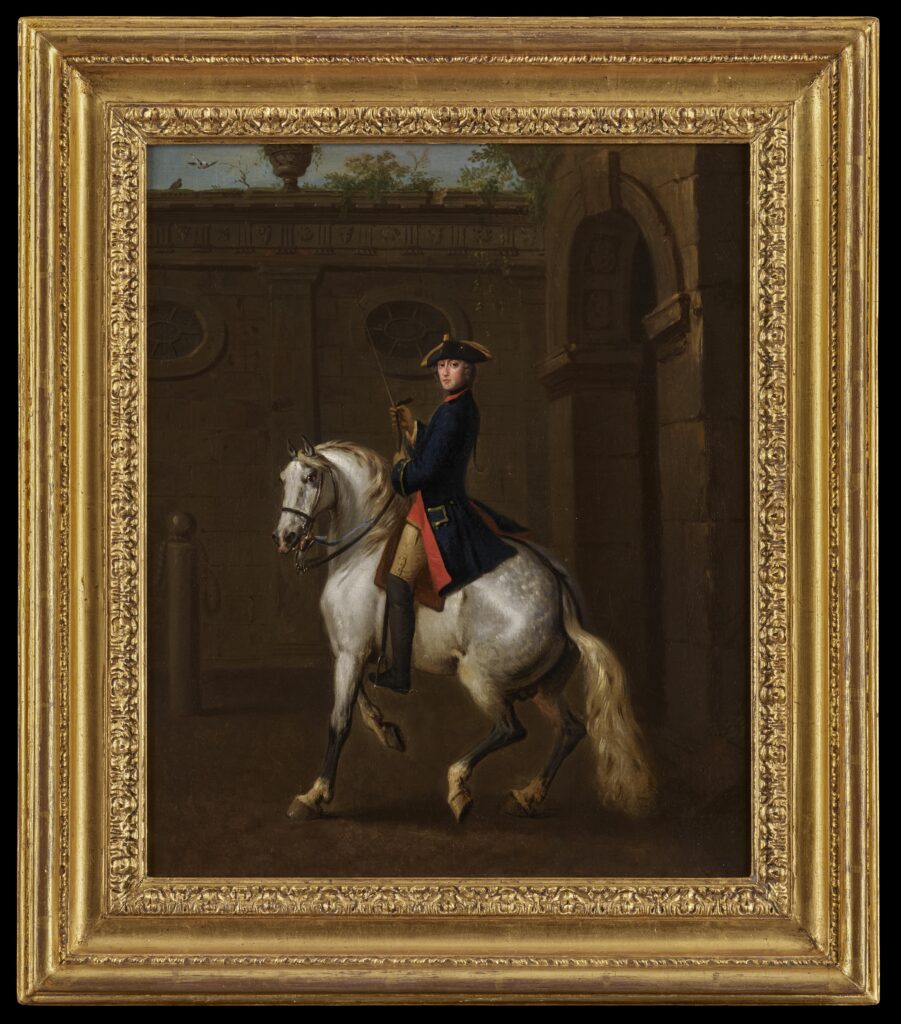
A Equestrian Portrait of a Gentleman thought to be Sir Hew Dalrymple, 2nd Bt, Lord Drummore (1712 – 1790)
Medium:
Oil on Canvas
Category:
Dimensions:
53.8(h) x 43.4(w) cms
Framed Dimensions:
68(h) x 58.5(w) cms
Signed:
Signed and dated lower right: 'I. Wootton / Fecit 1748'
Essay:
John Wootton was born in the small parish of Snitterfield in 1682 and became a pupil of Jan Wyck. It is widely thought that he had travelled to Italy as part of his early training but as yet no evidence hs been found to support this.
By 1706 Wootton had married Elizabeth Walsh and moved to London where he began to find great success. After the death of Elizabeth he married Rebecca Rutty, the daughter of a successful merchant. He was a subscriber to the first English Academy of Drawing and Painting in 1711 and was Steward of the Virtuosi Club of St. Luke's in 1717. From 1714 Wootton's reputation went from strength to strength and he spent his last years in a large house in Cavendish Square, a highly fashionable part of London. Interestingly, this property had recently been developed by his great patron Edward Harley. Wootton's pre-eminent position in England in the first half of the eighteenth century as a painter of sporting and landscape subjects was to go virtually unchallenged for almost four decades.
Among his most important patrons were King George II, his estranged son Frederick, Prince of Wales and also the Duke of Marlborough. His painting reflected the interests of the nobility and landed gentry and identified them with country life and its pursuits and he spent a great deal of time travelling to and from their country houses.
-
This portrait has traditionally been thought to represent Sir Hew (or Hugh) Dalrymple, a Scottish baronet and MP. He succeeded from his grandfather as 2nd Baronet Dalrymple, of North Berwick, in 1734. Sir Huw was the MP for Haddington Burghs from 1742 - 1768 and was King's Remembrance in the Scottish Exchequer 1768-70. He married first Margaret Sainthill (d. 1749) and later Martha Edwin (d. 1782).
Sir Hew lived in London and Scotland and spent much time improving and rebuilding North Berwick House, East Lothian. In a memorable and published letter to Sir Lawrence Dundas on 24 May 1775 he wrote:
‘Having spent a long life in pursuit of pleasure and health, I am now retired from the world in poverty and with the gout; so ... I go to church and say my prayers.’
Sir Hew was succeeded by his eldest son Hew, who later changed his name to Hamilton-Dalrymple in 1796 when he inherited the estate of Bargany from his wealthy uncle John Hamilton.
While the rider appears to be in an Italianate courtyard no mention of Sir Hew visiting Italy appears in his biographies, so this is likely a fantasy invented by Wootton presumably at Sir Hew's request. It appears that Sir Hew was well acquainted with the work of Wootton as his grandfather, the 1st Bt, purchased a painting of the famous racehorse Flying Childers by Wootton at an auction in Edinburgh in 1732.
Provenance:
(Probably) commissioned by Sir Hew Dalrymple (1712 - 1790);
By descent to Mrs Rosa Madox, née Hamilton Dalrymple Hamilton (ca 1802-1894), Pulteney Street, Bath;
By whom given to Mary Swan, Bath; (the above according to a label verso).
Private collection, UK.