Goffredo Wals
c.1600 - c.1638
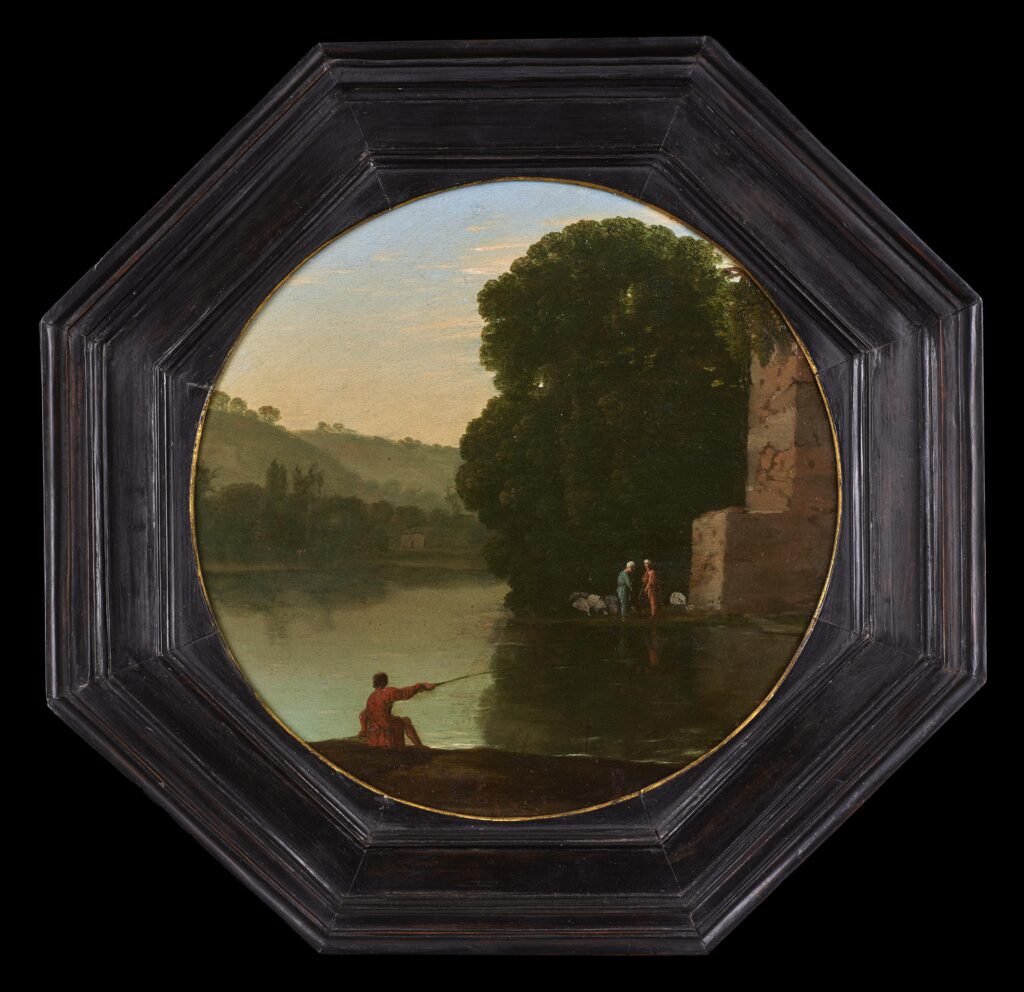
A Landscape with a Figure fishing on a Bank, with two Figures in the Middle-ground
Medium:
Oil on Copper
Category:
Dimensions:
17.5(h) x 17.5(w) cms
Framed Dimensions:
25(h) x 25(w) cms
Essay:
Goffredo Wals was born in Cologne and spent most of his short life in Italy where Baldinucci records him as a teacher of Claude in Naples in the early 1620s. He is thought to have been a pupil of Agostino Tassi in Rome from 1615 and was variously in Naples, Genoa and Sarona. Many pictures by Wals have been confused with those by Tassi, Breenbergh and Filippo Napoletano. It is believed that Wals died in an earthquake in Calabria, probably in the disastrous earthquake of 27 March 1638.
Typically, Wals painted on copper and usually in a circular format. The copper support allowed him to paint his lyrical Italianate landscapes in a way that was so unique to him but is also recognisable in Claude to a certain degree. The translucent colours that the copper provides give his landscapes a slightly mysterious quality that makes his paintings so appealing.
While only a few dozen works by Wals are known today a contemporary source suggested the artist executed sixty works, both paintings and drawings, for the Flemish merchant Gaspar Romer who lived in Naples, where Wals worked in the mid-1630s. Having faded into obscurity since his death, it is only since Roethlisberger 'rediscovered' Wals in the 1960s that the artist has received the attention by art historians that he deserves and so his oeuvre is slowly being reconstructed.
-
This copper roundel is an important addition to the small but distinguished number of paintings by Goffredo Wals. Wals' oeuvre comprised only nineteen works when documented in Anke Repp-Eckert's monograph published in 2006. It is pleasing to note that Wals's output was significantly more substantial than this and new works are still being found.
Working on small-scale on copper roundels was common for Wals, as was his preference for uncomplicated compositions featuring rivers or lakes, blocky ruined towers, and perhaps most distinctive, large bushy trees. We see all of these features in this tranquil scene with the pleasing additions of a fisherman and a pair of shepherds tending their flock. It also displays Wals's distinguished sensitivity to the effects of light and his interest in perspective. These features, so inspirational to Claude, make this capriccio by Wals somewhat enigmatic, its cropped tower and tiny isolated figures timeless and ethereal.
This sensation is heightened by the composition. This Wals has divided into four quarters: vertically down the line of the tree and its reflection in the water, and horizontally just below the middle of the copper, which gives the picture a sense of strict order, but also of unreality. This sense is also felt in the way that Wals has mathematically divided space vertically by doubling the height from the foreground to the middleground and then to background.
Only one work by Wals has been reliably dated and so dating the present picture is currently not possible.
Dr Anke Repp-Eckert has endorsed the attribution to Goffredo Wals on the basis of digital images.
Provenance:
Anon. sale; London, Christie's, 14 Feb. 1964, lot 166 (as 'Tassi'), for 25 guineas to Agnew;
With Thomas Agnew & Sons Ltd., London (as Italian School);
From whom acquired by Michael Jaffé (1923–1997), London, Cambridge and Somerset, April 1964;
Thence by descent;
Anon. sale; Dominic Winter, Cirencester, 13 March 2024, lot 7 (as manner of Agostini Buonamici Tassi);
Exhibitions:
London, Thomas Agnew & Sons Ltd., Small Pictures For Small Rooms: A Collection of Cabinet Pictures by Old Masters Ranging from the 15th to the 19th Centuries, 7 April – 9 May 1964, no. 21 (as Italian School, late 17th century).