Juan Van der Hamen y Leon
Madrid 1596 - c. 1632
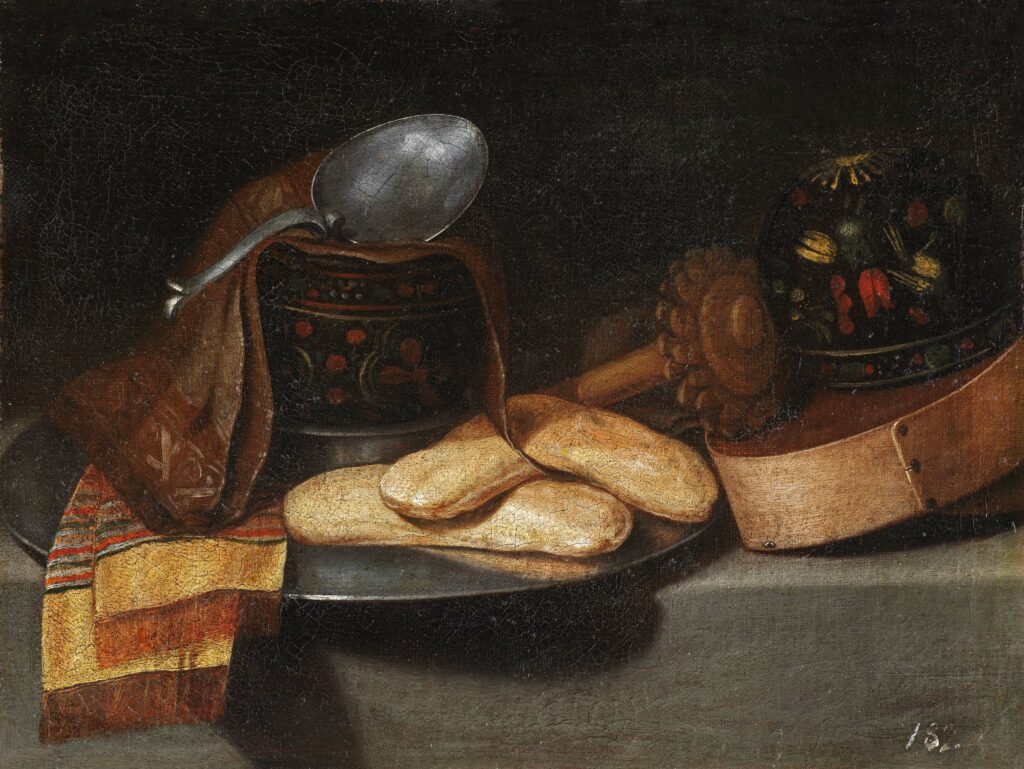
A Chocolate Service with a Wooden Box of Packed Chocolate, two lacquered Gourd Drinking Bowls, a Wooden Milk Whisk, Napkins, a Spoon and Pastries on a Pewter Plate
Essay:
The picture is inscribed on the reverse: no. 17./Vanderhamen y/ Leoni * Juan 1632 / no. Madrid 1596. no 163'.
We are grateful to Professor William Jordan for confirming the attribution and for dating the painting to circa 1621. Professor Peter Cherry also concurs with the attribution.
The present work is a recently rediscovered painting and a rare addition to the oeuvre of Juan Van der Hamen y León. This wonderful composition represents a chocolate service: a round, wooden box tilted at an angle, two black lacquer drinking cups and a wooden whisk for frothing melted chocolate. By the 17th century, chocolate became a popular commodity following the Spanish colonization of Mexico. The napkins and the drinking cups are also reminiscent of the New World with their mimic patterns; these were very much in vogue at the time and the cups appear to be the traditional Mesoamerican jicara made from a gourd. They were later replaced by the Spanish mancerina.
The wooden molinillo is a type of stirring spoon. One would squeeze the molinillo between your palms and spin it back and forth to give the chocolate drink a froth. This method of mixing chocolate replaced the Aztec style of pouring the chocolate over and over between the jicaras which was considered by the Spaniards a less efficient way of making the foam. The pastries are probably sweetened and would have been dipped into the chocolate. At this stage the chocolate itself was not always sweetened with sugar or spices and often the Spanish did not find the natural bitterness of cacao palatable. The round wooden box is a membrillo which usually stored fruit preserves but in van der Hamen's painting it presumably contains the chocolate.
We are grateful to Jaime Barrachina at the Museu del Castell de Peralada for his supposition that our painting is the earliest depiction of chocolate drinking items in Spanish painting.
Antonio Ponce, one of the most promising assistants in Van der Hamen’s workshop, quoted his master’s composition in a larger still life, see below. In fact, in his early career, Ponce was known to create still life pastiches, combining various elements, each of his master’s invention. The present work, with its sensitivity of brushwork, is without a doubt a lost original by Van der Hamen which his student repeated for his own compositions.
Provenance:
Anonymous sale, New York, Christie's, 12 January 1996, lot 131 (as Francisco Barrera);
Private Collection, USA