Louis-Nicolas van Blarenberghe
1716 – 1794
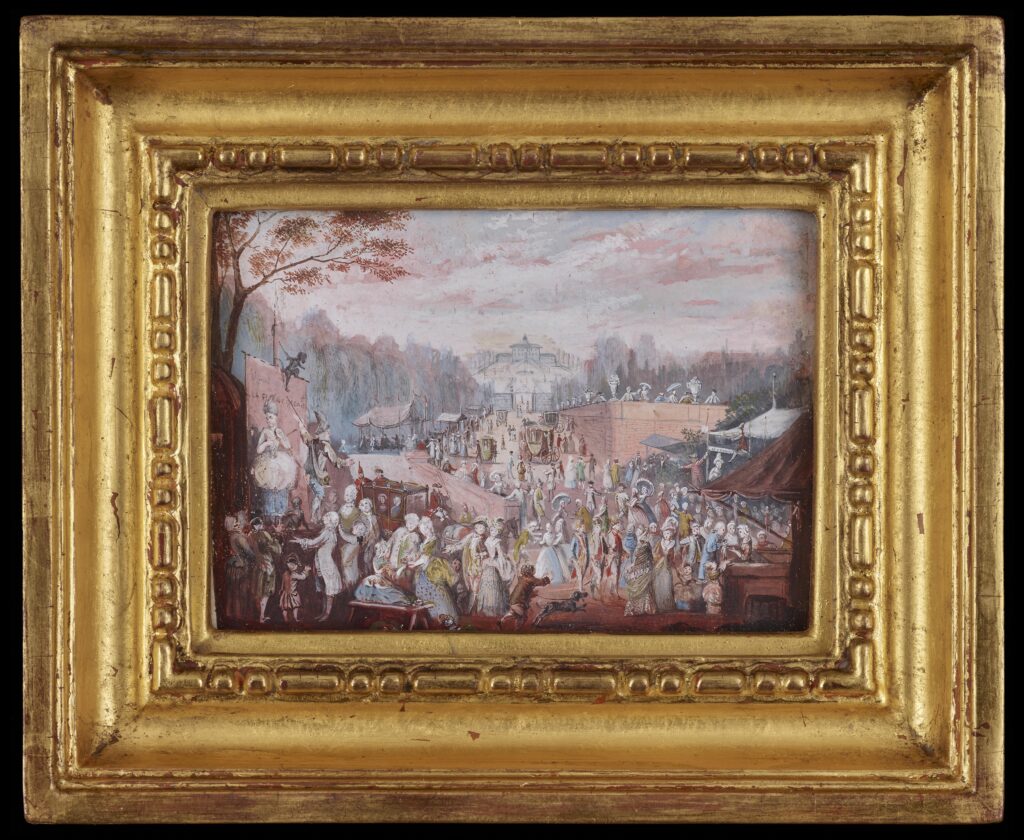
A Country Fair
Medium:
Watercolour & Gouache on Vellum
Category:
Dimensions:
8.3(h) x 10.8(w) cms
Framed Dimensions:
14(h) x 17(w) cms
Signed:
inscribed above the stage centre left: Venez voir LA Fe-me géante
Essay:
The son of the Flemish painter Jacques-Willem, Louis-Nicolas van Blarenberghe is considered his best pupil and a master of gouache and miniature painting.
In 1745-46 much of the fighting during the War of the Spanish Succession was not far from Lille, the town of Louis-Nicolas's birth. This proved to be a turning point in the artist's life as he would take the opportunity to court many potential aristocratic patrons from both sides of the warring factions, impressing them with his depictions of the battles that he had witnessed. Louis-Nicolas was clearly skilful at ingratiating himself with the court and by 1769 he had been appointed Battle Painter to Louis XV.
Working as the campaign painter for the French court, Louis-Nicolas followed the army in a manner not dissimilar to a war reporter. He also spent much time at the Palace of Versailles working on commissions for the aristocracy, often gouaches, miniatures, and paintings on decorative objects like snuff boxes. His most important commission is the series of twenty three gouaches painted for the French monarch depicting the Wars of Succession, which are still at Versailles today. Louis-Nicolas's aristocratic connections were vital for his livelihood and in particular his close friendship with Jean-Baptiste Berthier, the engineer and architect.
-
Lively fête champêtres, garden parties, and circuses were common subjects in Blarenberghe's miniatures. This example, teeming with merrymakers, is particularly interesting due to its minute size and the even smaller placard which invites everyone to "Come and see the giant woman". Two performing monkeys and a promoter excite the crowd amongst the grounds of a grand chateau full of well-dressed ladies and gentlemen, carriages and sedan chairs. To the right is a booth selling dolls and a flower seller sits on a bench in the foreground.
Blarenberghe often produced landscape miniatures. These would be displayed both as cabinet paintings and as decorations for snuffboxes. Blarenberghe would use gouache on vellum for the snuffboxes, and they were typically around the same dimensions as the present picture which suggests that it may have originally come from a snuffbox.
A similar slightly larger work exists with the same country park but with different festivities and staffage (Christie's, New York, 24 Jan. 2006, lot 113).
Provenance:
Private collection, UK.