Gabriel Gresly
1712 - 1756
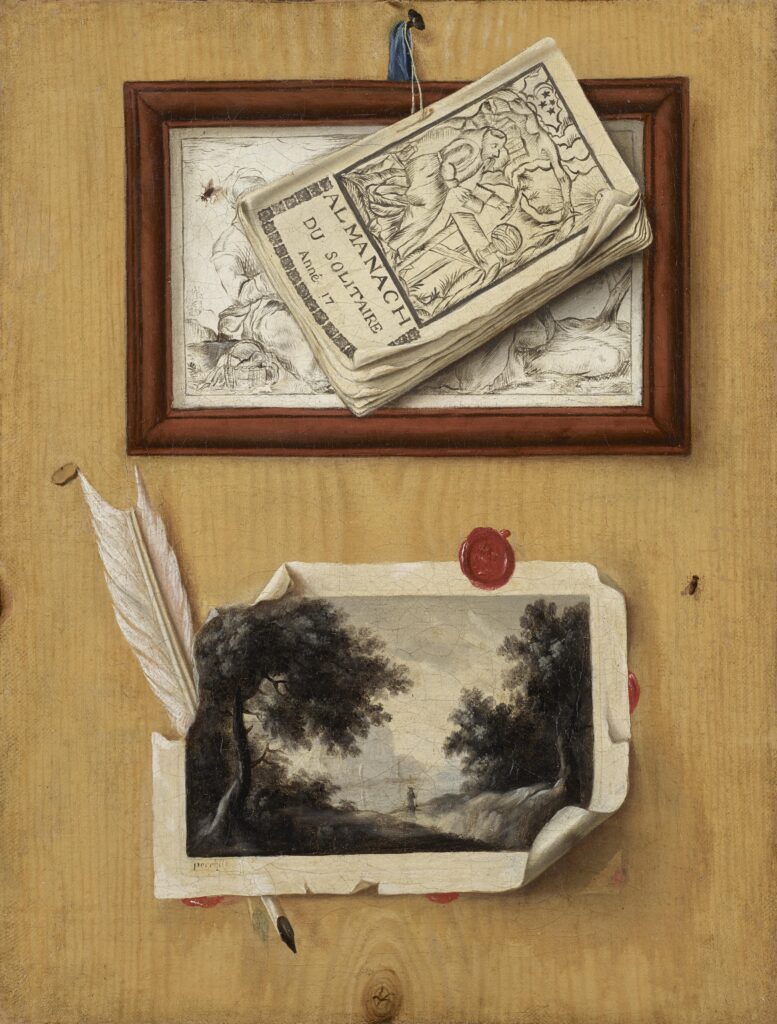
A Trompe l’Oeil of an Almanac, Drawings, a Goose Quill and Wax Seals displayed against a Deal Board
Essay:
Born on 8th January 1712 in L`Isle-sur-le-Doubs (near Besançon) the son of a glass maker, Gabriel Gresly was a self-taught artist who was well known in the Franche-Comté region. He spent most of his life working in Besançon producing portraits, genre paintings, still lifes and trompe l`oeil subjects until his death in 1756. In 1751 Gresly married Anne-Françoise Fraichot in Besançon, daughter of the painter Pierre Antoine Fraichot.
A story commonly told of Gresly was that on travelling around France as a young man to further his career he was shocked to discover that one of his paintings had preceded him to the city and was being sold as the work of a renowned master. Exposing the fraud gained him considerable notoriety, creating his reputation, and consequently he received a great number of commissions. It is recorded that in 1752 he travelled to Paris and came to the notice of the Comte de Caylus who acquired a number of works by the artist.
Gresly is particularly well known for his excellent trompe l'oeil paintings. These are always of high quality and usually contain prints, often after Gabriel Perelle, Rubens, or other well-known artists, and drawings pinned to wooden panelling often accompanied by quill pens, sticks of sealing wax, and letters. His pictures of prints with broken glass are particularly successful and are very rare. His trompe l'oeil often come in pairs and are sometimes dedicated to patrons, their names painted onto envelopes within the compositions.
-
This painting by Gresly is a typical trompe l'oeil composition by the artist. Arranged with a studied carelessness, the crinkled pages of a well-thumbed almanac obscures what appears to be a framed etching of a woman sitting outside. This is perhaps a biblical or allegorical scene. On the etching rests a fly, a typical and always delightful addition to a trompe l'oeil.
An almanac was quite an ephemeral item in the 18th century. It would be dated to a specific year (the last two digits are absent in Gresly's picture) and contained information on the zodiac, saints' days, festival days, and other general news relating to the year. The plate designs for the front covers were often reused and pirated by different publishers. For instance, another almanac with the same frontispiece as in our picture was printed in Gresly's native Besançon seven years after his death.
Fixed to the board with red wax, its corners curled and artfully torn, is an engraving of a wooded river landscape signed 'Perelle'. This probably refers to Gabriel Perelle (1604-1677) or one of his children who were all French painters and engravers of topographic views and landscapes. Engravings by Perelle appear regularly in Gresly's trompe l'oeil works. However, a corresponding engraving by one of the Perelle family has not been found.
A very similar painting by Gresly is in Béziers, Musée des Beaux-Arts. In this work the almanac is dated 1739 (providing a likely approximate date for the present picture) and the framed etching bears Gresly's own signature in the bottom left corner.
Dr Fred Meijer has confirmed the attribution of this painting after examining it first-hand.
Provenance:
Collection of the painter Louis Wijmans (1905-1994) since at least the 1950s,
Thence by descent to the previous owner.