Abraham Casembroot
c. 1593 - c. 1658
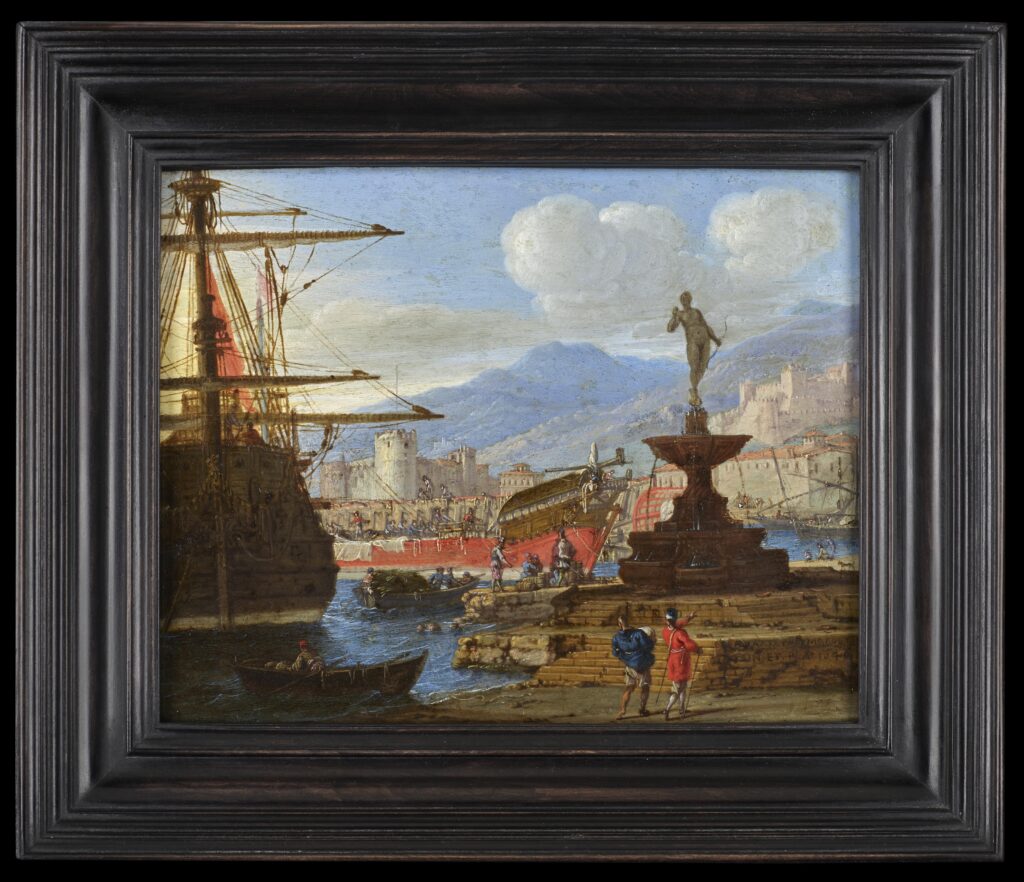
A View of an Italian Harbour with Shipping and a Fountain
Medium:
Oil on Copper
Category:
Dimensions:
18.4(h) x 23.1(w) cms
Framed Dimensions:
27(h) x 31.5(w) cms
Signed:
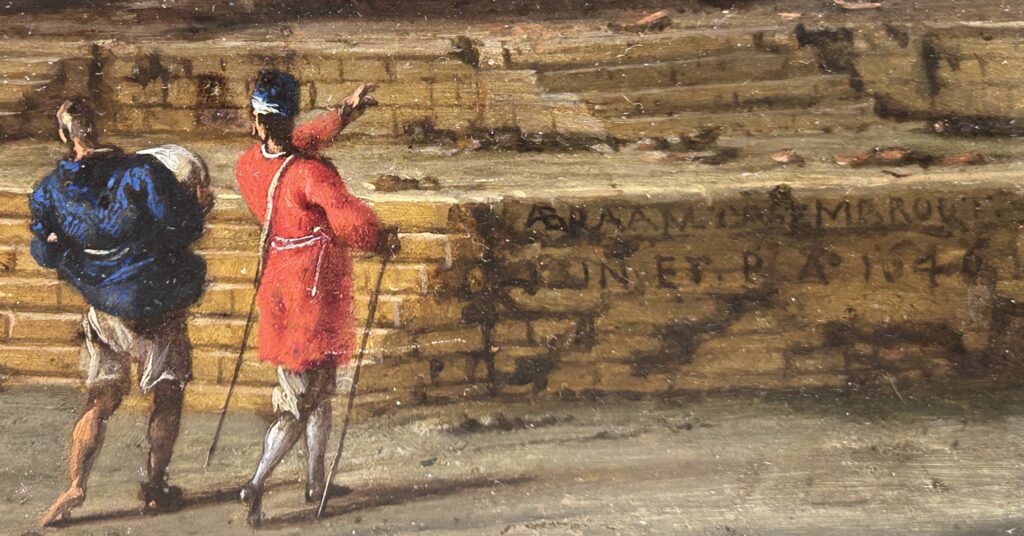
Signed and dated lower right: 'ABRAAM CASEMBROOT / IN ET P Ao 1646'
Essay:
Abraham Casembroot (or Casembrot) was probably born in Bruges and spent most of his working life in Messina on the east coast of Sicily. While he has left only a very small body of work in Messina he specialised in producing harbour scenes and pictures of boats often in pen and wash where is skill as a draughtsman is evident and full of vigour. His thirty-two surviving drawings of figures, ships and the port of Messina, are especially lively and sharp, and his small body of work left to us is fantastically original.
Casembroot settled in Messina in 1623 where he appears to have thrived and is recorded as having five local pupils and earned the nickname 'The Messinese Poussin’. Among his most famous works are the etchings Views of the Port of Messina, bound in a thirteen-folio book dedicated to the dealer and collector Lucas van Uffel. Casembroot received a major commission to paint three scenes of the Passion on copper for the church of San Gioacchino in Messina (built in 1645) which were lost in an earthquake in 1908. From 1649 he was consul of the Dutch Republic in Sicily.
A rare artist, only four autograph paintings by Casembroot are known. One large painting on canvas, The Swordfish Hunt in the Strait of Messina, dated 1644, is in the Museo de San Martino in Naples. There are, however, a group of his drawings and ink sketches in the Fitzwilliam Museum, Cambridge, which came from the collection of the Roman sculptor Bartolommeo Cavaceppi (c.1716 - 1799).
-
This vivacious little painting is an extremely rare work by Abraham Casembroot. It is one of only four signed paintings and, dated 1646, it is also the last. The copper exhibits his marvellous and very characteristic qualities as well as the subject matter for which the expatriate Fleming is best known - an Italianate harbour.
In her monograph on Casembroot (see lit.) Annamarie Beunen describes the present picture in the context of his oeuvre as '...het meest harmonieus wat betreft compositie, kleurgebruik en dieptewerking' [the most harmonious in terms of composition, use of colour, and depth of field]. This is a fact which Casembroot himself appears to have realised with his proud inscription ABRAAM CASEMBROOT / IN ET P - short for invenit et pinxit - "invented and painted".
A Spanish galley well stocked with rowers enters a harbour filled with dockworkers in boats or loitering on the quayside around a fountain with a statue of Diana creating a bustling scene. The hulking man-o-war seen from the stern is very typical and a ship in this profile appears often in his surviving handful of drawings, as does the pressing of the ship and architectural elements close to the picture plane. Vibrant reds and blues of the shining Mediterranean scene are also typical.
While Casembroot is closely associated with the city of Messina, the Christie's catalogue entry notes that the harbour and hill fort bears a closer resemblance to Naples than Messina suggesting that the scene is a capriccio. The fountain with the statue of Diana goddess of the hunt is an invention by Casembroot (there does not appear to be a record of it existing in Messina's harbour). A statue of Neptune would seem more appropriate so perhaps Diana's inclusion was requested by Casembroot's patron.
Provenance:
Consigned to Christie's, London, in 1983, but not entered into a sale
Anon. sale; Christie's, NY, 3 June 1987, lot 70
Private collection, USA.
Literature:
A. Beunen, 'Abraham Casembrot een Nederlandse schilder in het Sicilië van de zeventiende eeuw', in Oud Holland, 1995, p.37, illus. p. 36, cat. A4.