Giuseppe Borsato
1771 – 1849
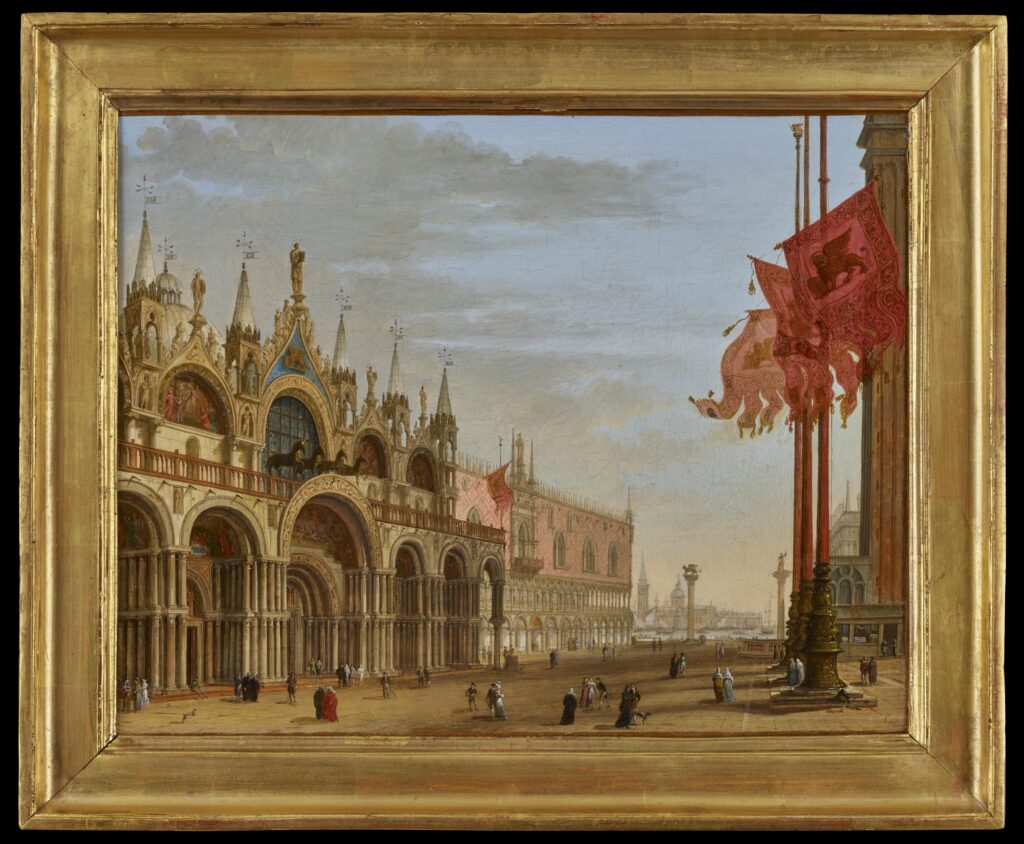
A View of St Mark’s Basilica and the Doge’s Palace
Medium:
Oil on Canvas
Category:
Dimensions:
38(h) x 49.5(w) cms
Framed Dimensions:
48(h) x 58(w) cms
Signed:
Signed and dated verso 'Borsato F. 1823'
Paired with:
Essay:
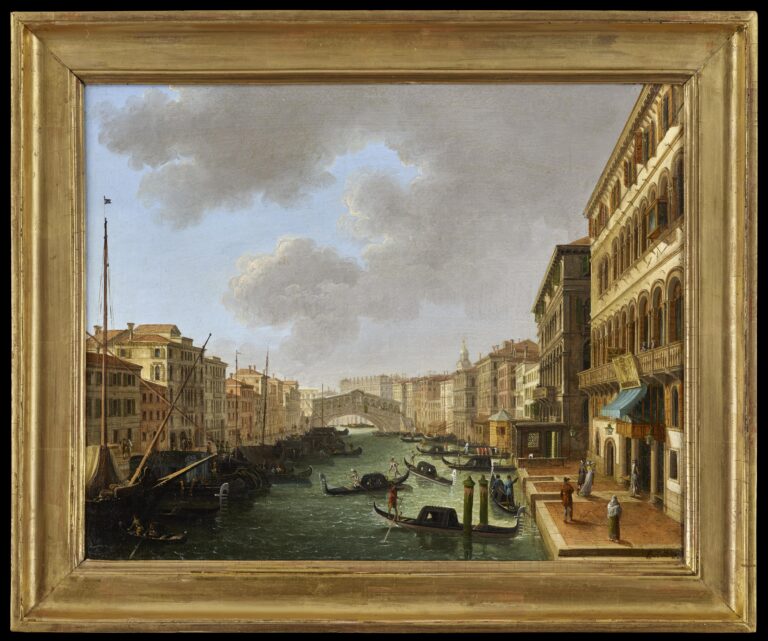
This painting is one of a pair.
Born in Venice in 1770, Giuseppe Borsato is best known for his architectural and landscape painting of the great city in the tradition of Canaletto and, more contemporarily, with 19th Century painters like Chilone, Migliara and Bison. However, he is still considered by many to be the last flowering of the great settecento Venetian vedute painters.
During the French occupation of Venice he was a key figure in devising designs for official celebrations. Borsato conceived a series of structures erected specially for this occasion and Baron Dominique Vivant -Denon commissioned six paintings from him describing the Venetian celebrations and the glory of the French Empire. These include a painting of Napleon entering the city on 29 November 1807 and another showing Napoleon presiding over the Regatta on 2 December 1807 (Palace of Versailles, object. nos. MV 1446 and 1447).
Having worked on the theatre in Treviso, Borsato was appointed "Scenografo Ufficiale" of the famous La Fenice theatre and he also became professor of ornamental art at the Venice Academy in 1812. His typically precise and detailed style produced pictorial, historical documents that closely recorded important events.
-
This view of St Marks' Square with the Basilica on the left looking towards the Grand Canal was painted several times by Borsato. Similar views include a version dated 1827 (exh. Galerie Grunwald, Munich, 1983) and a work in bodycolour on paper dated 1828 (sold Christie's, London, 5 Dec. 2012, lot 252). Our picture dated 1823 is the earliest of these and is the only one which crops the campanile.
The inclusion of the magnificent flag of the Venetian Republic (also known as the Standard of St Mark) is very distinctive. Typically, when views of the piazza were painted by earlier settecento artists only the bare flag poles are depicted, presumably so as not to occlude the architecture. The inclusion of The Standard of St Mark is curious for another reason. After the fall of the Republic of Venice in 1797 the flag was abolished by the Austrian conquerors. Dated 1823 our picture is harking back to the time of independence. In Borsato's later 1827 and 1828 views the flags have reverted to the red and white stripes of Austria.
While this painting could be read to imply a nationalistic (or even seditious) theme, it is unlikely that it reflects Borsato own leanings. Indeed, Borsato played an important role in the celebrations of French occupation of the city during the Napoleonic Wars painting scenes of Napoleon's entrance into the city and his presiding over the regatta. It is much more likely that the flags were included at the request of a grand tourist patron who wished to see La Serenissima through a lens of romance and history.
Both paintings are unlined on their original canvas.
Provenance:
Private collection, France