F. Marconi
Active in Rome by 1846
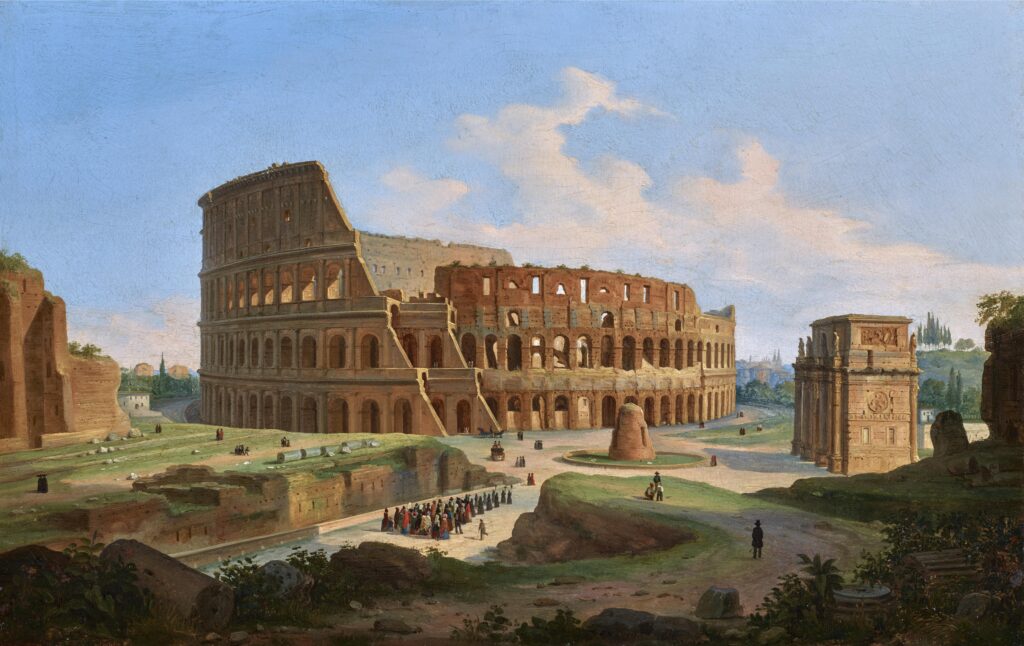
A View of the Colosseum, Rome
Medium:
Oil on Canvas
Category:
Dimensions:
29(h) x 46(w) cms
Signed:
Signed and dated on the stone lower centre: 'F. Marconi 1846'
Paired with:
Essay:
This picture is one of a pair.
It has been difficult to identify this artist who was evidently a very accomplished topographical painter working in Rome in the mid-19th century. Many landscape painters from across Europe and Italy were attracted to the city to execute some very beautiful and accomplished vedute.
One possibility as to the artist's identity is Ferrante Marconi (1798 - 1868). Born in Cesena into a family of artists, Ferrante studied at the Accademia di Belle Arti in Bologna from 1815-1826, a period of 11 years! Seemingly multi-talented, he won awards across the board and, in 1817 alone, was commended for a relief in the sculpture class, for another relief in the class of figurative elements, for a pencil drawing of Saint Jerome based on a print and, finally, for a hippogriff head in gouache. By 1819 he appears to have specialised in sculpture, winning several sculpture prizes including one for his replica of Sansovino's Bacchus.
On leaving the Accademia Ferrante mainly worked as a sculptor and in 1828 he followed his elder brother Enrico, also a sculptor, to Warsaw where they would cooperate on many important commissions of architectural decorations, funereal monuments and statues. Ferrante married a Polish lady named Dorota Elzbieta Hampl in 1830. The marriage was cut short by her untimely death in 1846 and it seems highly plausible that her widower would have sought solace in his native country, visiting Rome in that same year and painting the architectural monuments that dominate our pair of vedute. Highly popular with the Grand Tourists, these may of course have provided him with a source of income during his sabatical from the sculpture business in Warsaw. We know that the pull of Italy, and notably Rome, on the family was great: Of the couple's two sons one, Leonard, followed in his father's footsteps and found fame as a sculptor and architect, graduating first from the Academy of Fine Art in Warsaw and then, from 1859-62, transferring to the Accademia di San Luca in Rome.
-
A group of tourists are led by a procession of monks towards the Colosseum with the Arch of Constantine to the right. More tourists can be spied walking between the arcades of the structure and carriages arrive and depart to carry their charges. This bright, sunny scene was almost certainly painted for a Grand Tourist much like those presented here and follows in the tradition of vedute scenes of the previous century.
After the Napoleonic Wars tourism around Europe only became easier over the course of the 19th century. Whereas before it was typically only gentlemen of considerable wealth, classical students and artists who would risk travelling to Rome, by the 1840s families could come all the way from England in relative comfort and enjoy themselves in safety and luxury.
Provenance:
Private collection, UK