Francesco Guardi
1712 – 1793
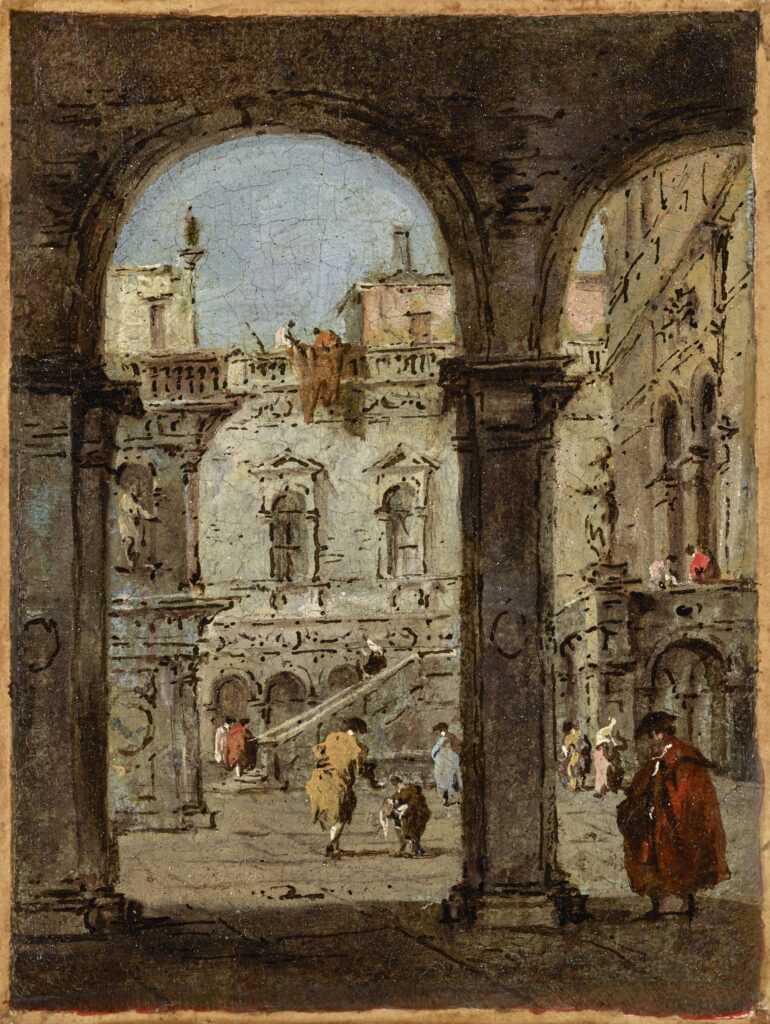
An Architectural Capriccio of a Courtyard
Essay:
This small recently rediscovered architectural capriccio reveals Francesco Guardi's verve as a painter and draughtsman. The composition exists with minor differences in two slightly larger paintings by Guardi. The first is 'An Architectural Caprice' in The National Gallery, London (NG2519) measuring 22.1 x 17.2 cm. The second is in The Wallace Collection, London inv. P647) measuring 38.6 x 28.9 cm. Both are dated to around the 1770s, a likely date for our own picture. As curators of both museums point out, though the view is imagined it evokes the architecture of the courtyard at the Doge's Palace in Venice with the staircase being closely modelled on the courtyard's Scala dei Giganti (Giant's Staircase).
The freedom of the brushwork lends the picture a sense of energy and immediacy, both of which are among Guardi's most admired qualities. The flurry of dark outlines, dots and dashes have much in common with Guardi's work as a draughtsman. The composition is connected to several sketches in ink and wash at the MET of similar courtyard views taken from different angles (for instance object no. 37.165.71). Guardi appears to have returned to the subject repeatedly, making small alterations. Another very small work by the artist of an intimate courtyard scene, and painted in a similar manner, was at Christie's, New York, 10 June 2022, lot 57 (sold for $453,600).
A note on the provenance:
This painting has been owned by three remarkable French gentlemen.
Étienne Arago was a politician, playwright, co-founder of the French newspaper Le Figaro, and was briefly the mayor of Paris in 1870 during the Franco-Prussian War.
Jacques Doucet was a fashion designer, pioneer of haute couture and one of the most important art patrons and collectors of his age. He collected works by French Old Masters and 18th century decorative art, as well as post-impressionists owning paintings by Picasso, Brancusi, Derain, Duchamp, de Chirico and Modigliani and was often advised in his purchases by André Breton.
Ernest Cognacq was a self-made man who left school at the age of 12 to become a travelling salesman around Charente-Maritime. Moving to Paris Ernest and his wife Marie-Louise Jaÿ began the clothing store La Samaritaine which became one of Paris's first grand Art Nouveau department stores. Much of their collection now makes up the Musée Cognacq-Jay.
Provenance:
Collection of Étienne Arago (1802 - 1892),
His sale; Hotel Drouot, Paris, 24 May 1899, lot 8 (sold for 1,500 francs).
Collection of Jacques Doucet (1853 - 1929),
His sale; Galerie Georges Petit, Paris, 6 June 1912, lot 164 (sold for 7,200 francs).
Collection of Ernest Cognacq (1839 - 1928).
Cognacq Museum, Paris, 1930 (according to a note at The Witt Library).
Private collection, USA.