Jacob Isaacksz. van Ruisdael
1628 - 1682
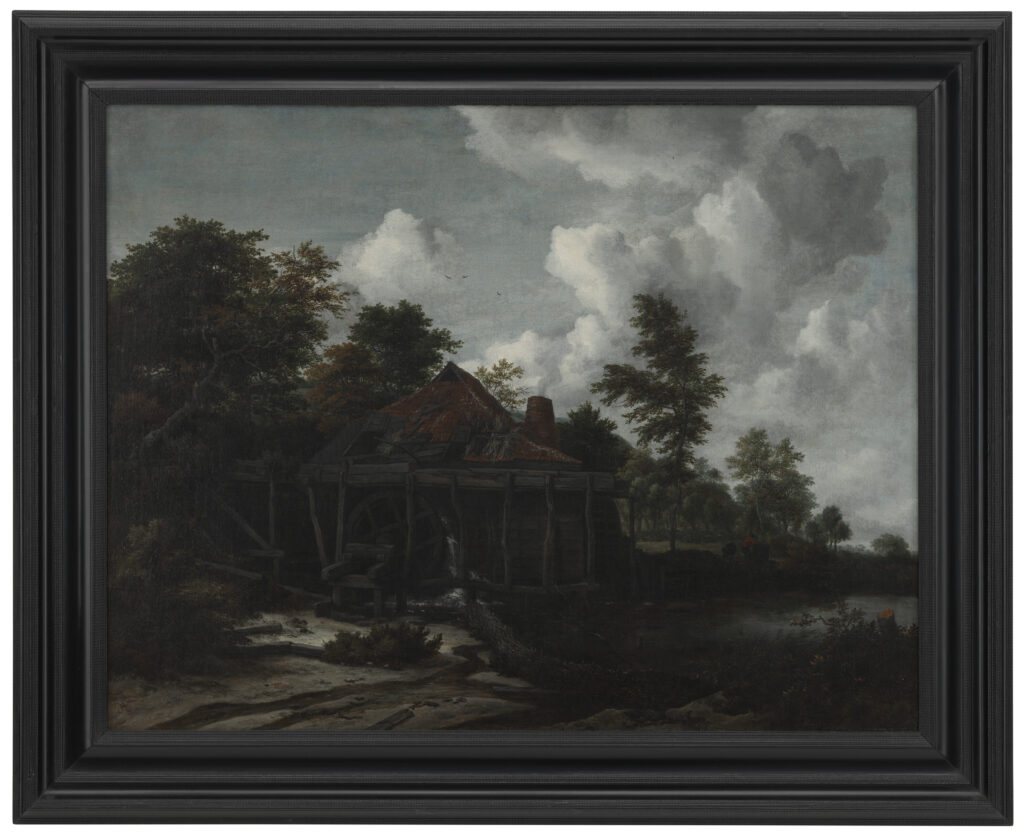
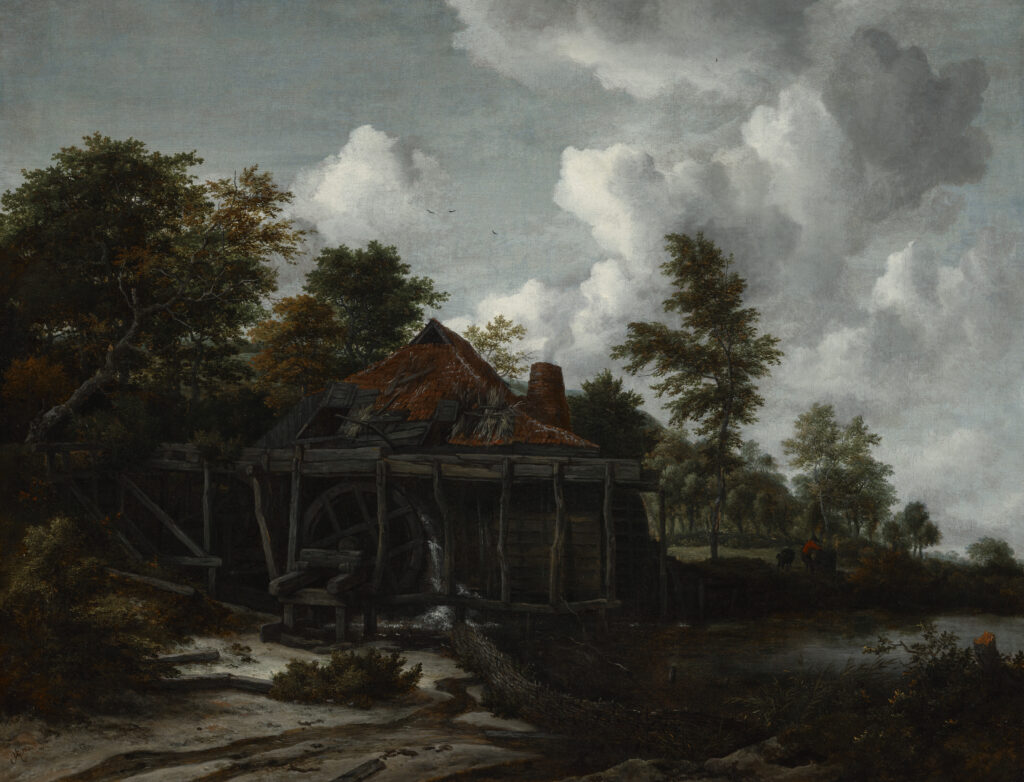
Overshot Watermill at the Edge of a Wood
Medium:
Oil on Canvas
Category:
Dimensions:
75.5(h) x 98.4(w) cms
Framed Dimensions:
95(h) x 116(w) cms
Signed:
signed with monogram lower left: 'JVR'
Essay:
Jacob van Ruisdael was undoubtedly the greatest and most influential landscape painter of the Dutch school in the seventeenth century. His formative years were spent in Haarlem, where he is presumed to have been a pupil of his father Isaac Jacobsz. van Ruisdael and influenced by his uncle Salomon Jacobsz. van Ruysdael. Other artistic influences on Ruisdael came from Jan Porcellis and Simon de Vlieger, in particular in his rarer maritime scenes.
In 1648 he entered the Guild of Haarlem and in 1653 Ruisdael made the short move from Haarlem to Amsterdam where he remained for the rest of his life. He travelled in Germany in 1650 and his visit there influenced his work after he had seen the dramatic German landscape. He may have stayed with Nicolaes Berchem and later on, on a further visit there in 1661 travelled with his great pupil, Meindert Hobbema. Ruisdael's early works are simple in composition, gradually becoming more spectacular with attention being paid to the effects of light and shade. After 1650 he painted grave, imposing landscapes which became increasingly more melancholic. In his later career he painted Scandinavian mountain landscapes, which show a great deal of influence of Allart van Everdingen, and some rare views of Amsterdam.
-
Early in his career, in the 1650s, Ruisdael travelled to the borderlands between the Netherlands and Germany, in Gelderland, Overijssel and Westphalia with Nicolaes Berchem. Here he encountered the particular types of castles, timbered houses and watermills he would go on to incorporate in his drawings and paintings for the rest of his career. His depictions of these tile-roofed mills constitute a relatively small, but important, group in his oeuvre, which Slive assigns to the 1650s. Only one such work is dated, Two Watermills and an open sluice, 1653 (J. Paul Getty Museum, Los Angeles, inv. no. 82.PA.18). As Slive notes Ruisdael virtually stopped dating his paintings after this year.
It is often unclear whether Ruisdael’s mills were faithful representations of known sites, or more liberally invented ideas set within an idyllic countryside, but he was undeniably fixated by one particular timbered, tile-roofed overshot watermill, of a type found in the eastern province of Gelderland. A worked-up drawing of this mill in the Rijksmuseum, Amsterdam (no. A 1392) is considered by Slive to be a preparatory study for our painting. In the finished painting Ruisdael extends the composition to the right, setting the mill more comfortably into its surroundings, and balancing it with the towering clouds. In total Ruisdael made four drawings of the same mill from varying viewpoints, all of which served as studies for finished paintings, one of which is in the Instituut Collectie Nederland, The Hague (inv. no. NK 1773) and another is in the National Gallery of Victoria, Melbourne (acc. no. 1249-3).
An untraced copy of the present work by Ruisdael’s pupil Meindert Hobbema is dated by Slive to the late 1650s, thereby providing a reasonably reliable terminus ante quem for the present painting (present location unknown; Slive, 2001, op. cit., p. 142, fig. 124a). Hobbema went on to make several of his own paintings and drawings of the same mill and the motif became a speciality of his, but it was his teacher who pioneered the subject.
Provenance:
M. Marin; his sale, Lebrun, Paris, 22 March 1790, lot 141 (1,010 livres to J. Desmarest).
Claude Tolozan (1728-1796), Paris;
His sale, Paillet, Paris, 26 Feb. 1801, lot 99 (2,455 livres to de Depernon).
Pierre Rambaut; his sale, Henry, Paris, 1 April 1817, lot 61 (4,000 francs to Bouché).
Jean-Pierre Varroc or Pierre Joseph Lafontaine; his sale, Henry, Paris, 28 May-2 June 1821, lot 70 (5,500 francs to Laneuville).
Anon. sale; Phillips, London, 29 June 1830, lot 78, where unsold.
Anon. sale; Phillips, London, 20 July 1835, lot 143 (240 gns.).
Charles Scarisbrick (1801-1860), Scarisbrick Hall and Wrighton Hall, Lancashire;
His sale, Christie's, London, 13 May 1861, lot 229, where acquired for 200 gns. by,
John Tayleur (before 1840-1922), Buntingsdale Hall, Market Drayton, Shropshire;
His sale, Christie's, London, 13 April 1923, lot 53, where acquired for 2,300 gns. by
Knoedler Gallery, London and New York, where acquired on 12 Nov. 1923 by,
Frank Porter Wood (1882-1955), Toronto, Ontario, from whom acquired in shares by,
Knoedler Gallery, Scott & Fowles, and Colnaghi, from whom acquired on 20 Nov.1925 by,
Vose Galleries, Boston, Massachusetts.
Clement Orville Miniger (1874-1944), Perrysburg, Ohio, and by descent to his daughter,
Mrs George M. Jones, Jr., Toledo, Ohio, by whom given in 1975 to,
Toledo Museum of Art, Ohio (Acc. no. 75.86), by whom sold to benefit the acquisitions fund,
Their sale; Sotheby's, New York, 25 January 2007, lot 62 (lot sold $132,000),
with Kunsthandel Xaver Scheidwimmer, Munich, where acquired on 15 March 2012 by the late owner.
Literature:
J. Smith, A Catalogue Raisonné of the Works of the Most Eminent Dutch, Flemish, and French Painters, London, 1835, VI, p. 27, no. 68, and p. 101, no. 322.
C. Blanc, Le Trésor de la Curiosité..., Paris, 1858, II, pp. 188, 347-348.
C. Hofstede de Groot, A Catalogue Raisonné of the Works of the Most Eminent Dutch Painters of the Seventeenth Century, London, 1912, VI, p. 56, no. 161, and p. 58, no. 169b.
F. Lugt, Les dessins des écoles du nord de la collection Dutuit au Musée des Beaux-Arts de la Ville de Paris, Paris, 1927, p. 23, under no. 42.
J. Rosenberg, Jacob van Ruisdael, Berlin, 1928, p. 111, no. 629.
K.E. Simon, Jacob van Ruisdael: Eine Darstellung seiner Entwicklung, Berlin, 1930, pp. 74 and 82.
G. Broulhiet, Meindert Hobbema (1638-1709), Paris, 1938, p. 103, fig. 2, as Meindert Hobbema.
L.D.J. Frerichs, Keuze van tekeningen bewaard in het Rijksprentenkabinet, Rijksmuseum, Amsterdam, 1963, pp. 55-56, under no. 73, as Meindert Hobbema.
S. Slive, 'Additions to Jacob van Ruisdael', The Burlington Magazine, CXXXIII, no. 1062, September 1991, p. 602.
E. John Walford, Jacob van Ruisdael and the Perception of Landscape, New Haven and London, 1991, pp. 124-125, fig. 128.
J. Edwards, Alexandre-Joseph Paillet: Expert et marchand de tableaux à la fin du XVIIIe siècle, Paris, 1996, p. 297, no. 99.
S. Slive, Jacob van Ruisdael: A Complete Catalogue of his Paintings, Drawings and Etchings, London and New Haven, 2001, pp. 142-143, no. 124, and pp. 496-497, under no. D6.
S. Slive, in Jacob van Ruisdael: Master of Landscape, exh. cat., London, 2005, p. 190, under no. 75, fig. 74a.
S. Slive, Jacob van Ruisdael: Windmills and Water Mills, Los Angeles, 2011, pp. 74 and 76, fig. 52, illustrated in colour.
Exhibitions:
The Hague, Koninklijke Kunstzaal Kleykamp, Tentoonstelling van schilderijen door oud-Hollandsche en Vlaamsche Meesters, 1925, no. 46.