William Melville
active 1815 - 1851
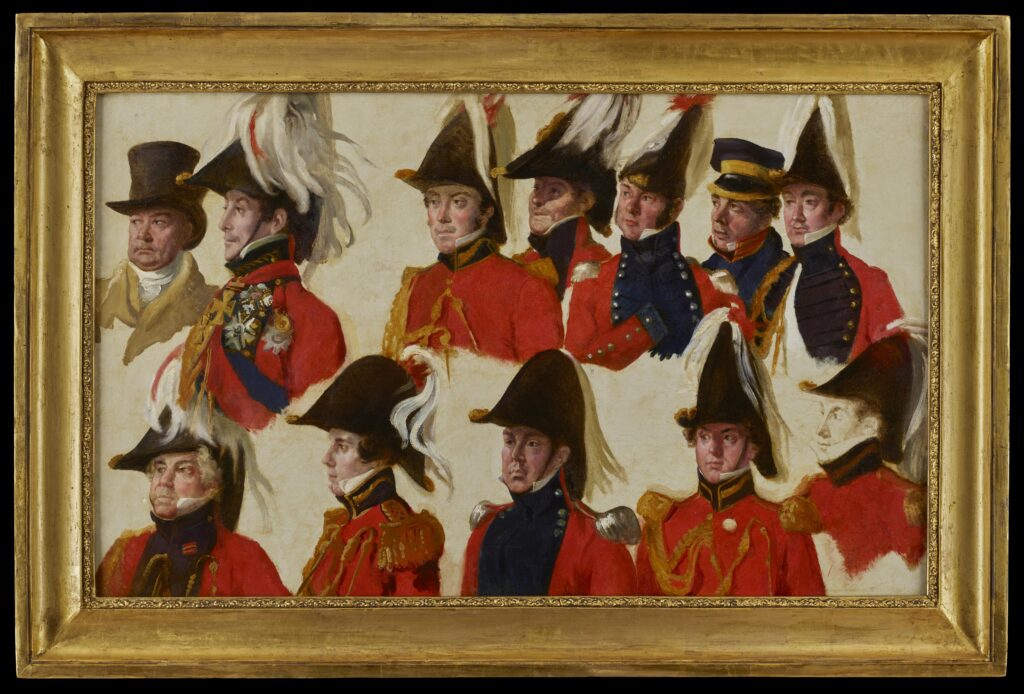
Portraits of Lord Metcalfe (1775-1846), Stapleton Cotton (1773 – 1865), later Lord Combermere, and members of his staff after the Siege of Bharatpur
Medium:
Oil on Canvas
Category:
Dimensions:
48.5(h) x 82(w) cms
Framed Dimensions:
64(h) x 97(w) cms
Signed:
inscribed faintly upper right: NCOs
Essay:
William Melville arrived in India at an early age and worked as a merchant for the Calcutta firm Fairlie Fergusson & Co. between 1824 and 1832. The firm failed in the mid 1830s causing Melville to rely solely on his artistic talents which he had been practicing during the 1820s. Insolvency announcements in the London Gazette show that he was dogged by the financial fall out of the Fairlie Fergusson debacle for some years to come.
Melville travelled up country and secured a commission to paint the portrait of Begum Samru (1753 - 1836), a former nautch girl (a professional dancer and courtesan) who rose to become the formidable ruler of Sardhana, a small principality near Meerut. His portrait of the fabulously rich Begum was originally intended for her new palace built in 1834. It was later purchased for Government House, Allahabad.
In 1836 Melville painted the portrait of one of the most colourful figures of pre-Raj India, Colonel James Skinner, C.B., of the 1st Regiment of Local Horse, for the vestry of the church he founded at Delhi. Melville also painted landscapes. Other extant works include a portrait of an Officer of an East India Company Rifle Regiment, 1846 (Royal Armouries, Leeds); two scenes on the Ganges, probably Bihar, c.1848 (British High Commission, New Delhi, India).
-
This series of portrait heads represents key British figures involved in the Siege of Bharatpur (formerly known as Bhurtpore) 11 December 1825 - 18 January 1826 in what is today Rajasthan 30 miles west of Agra. The capture of the seemingly impregnable fortress was a remarkable and much lauded victory for the British forces and was a pivotal moment in the careers of the two most significant characters in this painting: Sir Charles Theophilus Metcalfe (1775 - 1846), later Lord Metcalfe, and Stapleton Cotton (1773 - 1865), later Lord Combermere.
Metcalfe (top left) was the son of Maj. Thomas Metcalfe (1745 - 1813), Director of the East India Company from 1789 - 1813. Metcalfe followed his father into the Company and after spending many years in key political posts in Delhi and the frontiers he was appointed as acting Governor-General in March 1835 which made him the de facto ruler of the country. However, he only held the post for one year after passing the controversial Press Act. With this Act Metcalfe seriously strained his relations with the Company back in Britain due to its liberation of the Indian press, but won huge popularity in India among both Indians and Europeans. He resigned from the Company on 1 Jan. 1838 and returned to England with an enviable reputation, a fortune of £100,000, and a peerage. Soon after he accepted the governorship of Jamaica from 1839 - 1842 and later Canada.
Combermere (top row, second from the left) is identifiable by his many medals. On his chest he wears a Waterloo medal, a Breast star of the Order of the Bath, the Grand cross star of the Royal Guelphic Order, and a rare Army Gold Cross with one additional bar. Only 164 crosses were awarded to Lieutenant Colonels and above who had been involved in at least four actions during the Peninsular War with a bar or clasp added for additional actions fought. Combermere was highly praised by the Duke of Wellington for his action at the Battle of Salamanca in July 1812 where after witnessing a charge led by Combermere he exclaimed, "By God, Cotton, I never saw anything so beautiful in my life; the day is yours."
The identity of the other soldiers is more difficult to ascertain with certainty. By the gold brocade on most of their uniforms they appear to be aides-de-camps to Lord Combermere. Presumably these men were key army staff who played significant roles in the siege and storming of Bharatpur. In some instances their likenesses can be judged from later portraits.
Top row from left to right following Combermere:
3
Brigadier-General Sir James Wallace Sleigh CB (1775–1865); played a significant role in the siege capturing 6/7,000 troops. His portrait was painted by William Salter.
4
Major-General Sir Thomas Reynell (1777–1848); led the principal attack on the fort and was also painted by Salter.
5
To Reynell's right is a man missing his right hand. This is perhaps Captain Robert E. Chambers (1790 - 1842) who commanded the 9th Bengal Light Cavalry at Bhurtpore and was severely wounded in the hand at the siege.
6
In Combermere's memoirs published in 1866 he lists his staff present during his passage to India which includes Lieut. Col. Edward Kelly (1771 - 1828) a hero of Waterloo. In a series of lithograph prints of the siege William Henry Hutchisson illustrates Kelly wearing a blue uniform and cap suggesting that he is the soldier top row second from the right.
7
The last man on the top row is possibly Lieut.-Gen. Hon. John Finch CB (c.1792 - 1856) who was the military secretary to Combermere.
Bottom row:
1
Unidentified older aides-de-camp who is wearing a Waterloo ribbon.
2
Major-General Godfrey Charles Mundy (1804 – 1860).
3
An unidentified officer.
4
An unidentified aides-de-camp with a Waterloo medal.
5
Possibly Lieutenant-General Sir Jasper Nicolls KCB (1778 – 1849) who directed the second principal assault.
Of the three unidentified men it is likely that they include aides-de-camp who are mentioned in Combermere's 1866 posthumous memoirs such as Captain Turner Macan, 16th Lancers, Persian interpreter; Captain J. H. Dawkins, Grenadier Guards, Captain E. Archer, unattached; Captain W. Agnew, 2nd M.N.I.; Major A. Lockett, 63rd B.N.I.; and Hugh Smith, Esq., Surgeon.
The Siege of Bharatpur:
The Siege of Bharatpur was precipitated by the suspicious death of the ruler of region Maharaja Baldeo Singh. His six year-old son Bulwant Singh, rightful heir to the throne, was recognised by the Govenor-General of India, but the deceased king's cousin Durgan Sal seized power and commanded an army of Jat warriors from the fort of Bharatpur. In order to pacify the area, and to consolidate British power in the thus far largely independent northern Indian states, the British decided it was time to intervene.
A fortress believed to be impregnable, the assault on Bharatpur was orchestrated by Combermere, general and Commander-in-Chief of India working together with Sir Charles Metcalfe who authorised the attack and who was stationed nearby. The garrison held 25,000 men with artillery. The British dug lines of trenches ("parallels") for their own artillery and for sappers to plant mines.
On 18 January after various breeches in the walls were made (the largest mine containing a massive 10,000 lbs. of powder) the fort was stormed and captured. It is worth noting that Gurkha soldiers fighting for the British played a decisive role in the battle. Durgan Sal was captured whilst trying to flee. It was estimated that around 13,000 men in the garrison and 1,000 British troops were killed or wounded. On 5th February Bulwant Singh was formally reinstated by Combermere and Sir Charles Metcalfe.
We are grateful to James Rawlins for identifying Lord Combermere and suggesting the overall theme of the Siege of Bharatpur.
Provenance:
By family repute descended in the family of Lord Metcalfe (1775-1846);
E. J. Metcalfe, Majorca, 1960s;
By descent to his daughter;
Private collection, UK.