David Teniers The Younger
1610 – 1690
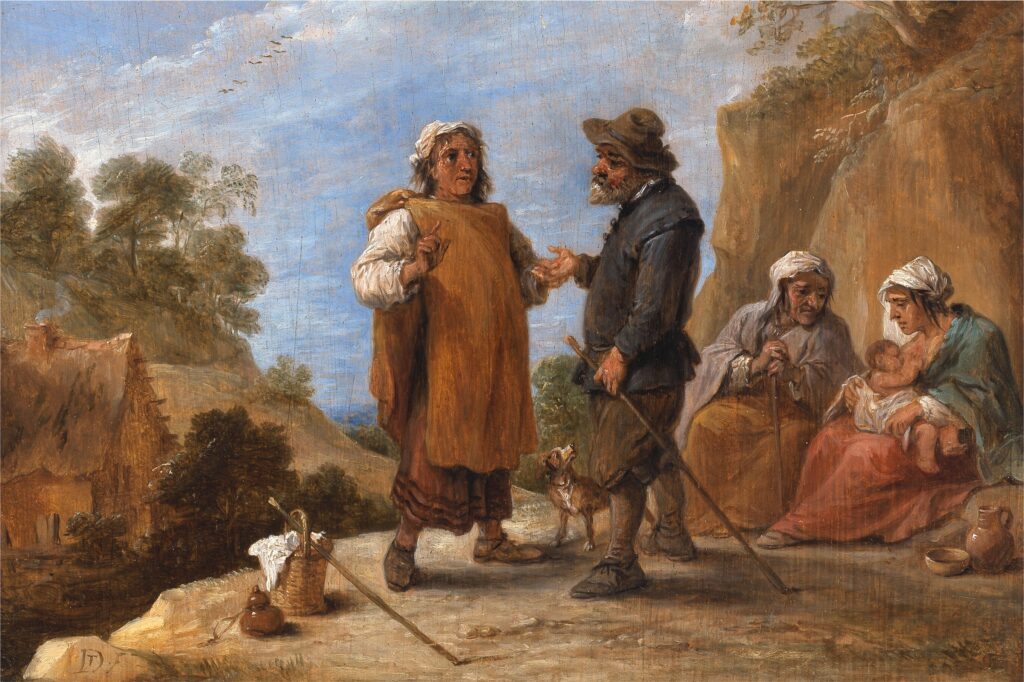
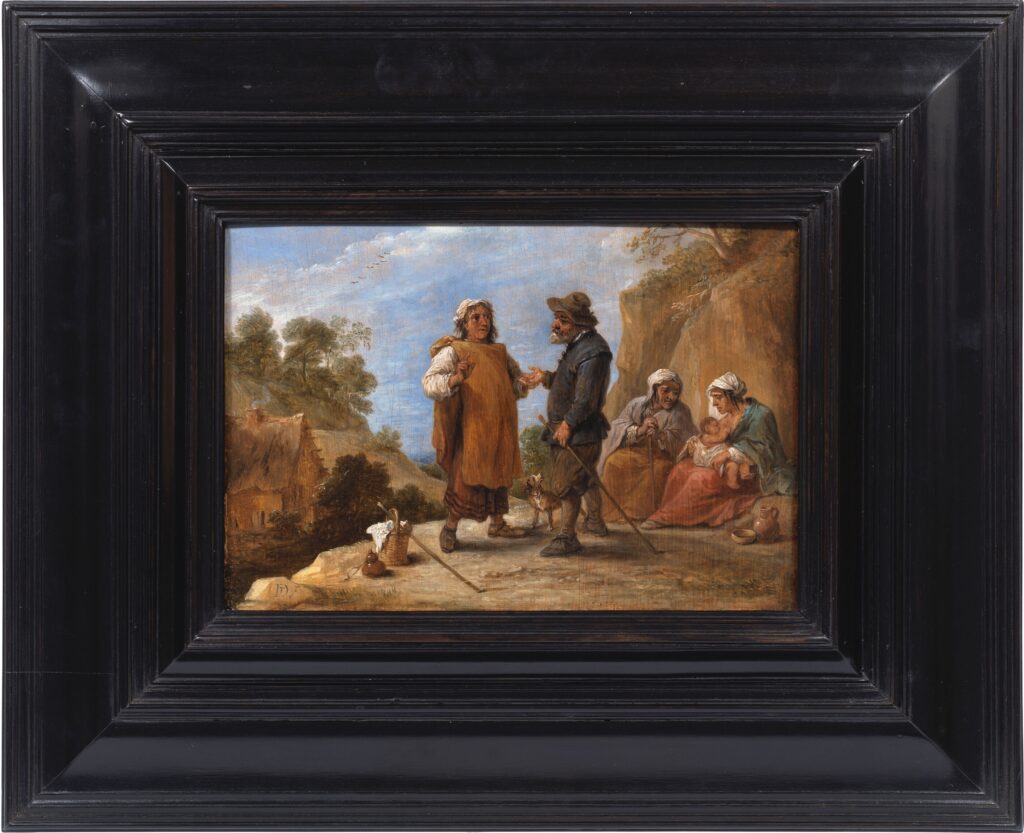
The Fortune Teller
Medium:
Oil on Panel
Category:
Dimensions:
17(h) x 25(w) cms
Framed Dimensions:
36(h) x 44(w) cms
Signed:
Signed lower left with monogram: 'DT F'
Essay:
David Teniers was the son and pupil of David Teniers the Elder and lived in Antwerp, joining the Guild in 1632. In 1637 he married Anna, the daughter of Jan Brueghel I. His output was prolific and it seems this success was in part due to his good working relationship with the Antwerp art dealers. David Teniers became a central figure in Antwerp, holding the prestigious post of Master of the Chapel of the Holy Sacrament in the St. Jacob's Kerk from 1637 to 1639. He also became dean of the Guild of St. Luke from 1644-5. These positions in turn gained him many important commissions from highly important and wealthy patrons in the Southern Netherlands, notably Antonine Triest, Bishop of Bruges.
By 1647 Teniers was working for Archduke Leopold Wilhelm and was made his court painter in 1651 (Teniers paintings of his private gallery are amongst some of the best known images in western art). In 1651 he moved from Antwerp to Brussels to be nearer his illustrious patron. Teniers was devastated by the loss of his wife in 1656 and remarried very quickly to Isabelle de Fren. In 1663 he was one of the founders of the Academy in Antwerp and was appointed its first director. His second wife died in 1683.
Teniers is known as an important painter of landscapes, genre scenes and portraits. His early style was like that of Adriaen Brouwer, who was a great influence on him, but his later personal style is lighter, with stronger local colours and well-drawn figures which became of increasing importance within his landscapes. The fulfilment of his work can be seen in the many variations of harvest and village dancing scenes. His depiction of wine kegs, kitchen utensils and furniture are detailed with small areas of some paintings constituting still lifes in themselves. He painted religious subjects, mythology and scenes of ghosts and witches and, of course, his well-known genre-type pictures of anthropomorphic cats and monkeys.
Even in his own lifetime, paintings by Teniers were highly prized and he is known to have contributed figures to the landscapes of several contemporary artists, especially those of Jacques d'Arthois.
-
David Teniers the Younger painted many variations of this subject, three of which are today in the Prado, Madrid (Inv. no. 1818), The Kunstmuseum, Basel (Inv. no. 1111) and The Staatliche Kunsthalle, Karlsruhe (Inv. 1899). These pictures, sharing stylistic elements and the monogram signature 'DT F' (also present in our version), are dated to the 1640s which suggests an approximate date for our picture.
The grouping of three or four gypsies, two sitting, with one reading the palm of an old peasant on a rocky road persists in the other versions. What is particular to the present picture is the landscape is reduced in scale and the figures are in turn magnified so that their careworn expressions of guile and gullibility are evident.
At the time of the 1989 sale, the painting was accepted as David Teniers the Younger by Dr Margaret Klinge.
A note on the provenance:
Sir Thomas Baring's will dictated that his renowned collection of old master paintings, amassed from the vast fortune generated by Barings Bank, be sold at public auction. However, Sir Thomas’s second son, Thomas Baring, MP, purchased many of the finest paintings from the estate at the two-day sale on June 2 and 3, 1848, including the present work.
In 1873, Thomas George Baring, 1st Earl of Northbrook, inherited the collection amassed by his uncle, Thomas Baring, MP. It was in turn inherited by Francis Baring, the 2nd Earl of Northbrook. Upon the second Earl's death in 1927 the collection was then dispersed piecemeal over the following years with Joseph Duveen handling the very best works including Self-Portrait playing the Lute by Jan Steen (Museo Nacional Thyssen-Bornemisza, Madrid), The Intruder by Gabriel Metsu (National Gallery of Art, Washington) and The Lenti Madonna by Carlo Crivelli (today in the MET).
Provenance:
Sir Thomas Baring, 2nd Bart. (1772 - 1848), Stratton Park and Devonshire Place
His estate sale; Christie's, London, 3 June 1848, lot 77 (sold for £21)
Acquired from the above sale by Thomas Baring, MP (1799 – 1873)
By descent to his nephew Thomas Baring, 1st Earl of Northbrook (1826 - 1904)
By descent to his son Francis Baring, 2nd Earl of Northbrook (1850 - 1929), 42 Portman Square, London, (photographed in the Northbrook collection c. 1927)
Anon. sale; Christie's, New York, 11 Jan. 1989, lot 84 (From a Private Collection)
With Rafael Valls, London, 1989
Private European Collection
Literature:
W. H. J. Weale and J. P. Richter, A Descriptive Catalogue of the Collection of Pictures Belonging to the Earl of Northbrook, London, 1889, p. 72, cat. no. 100 (as David Teniers the Elder)