Dominic Serres
1722 – 1793
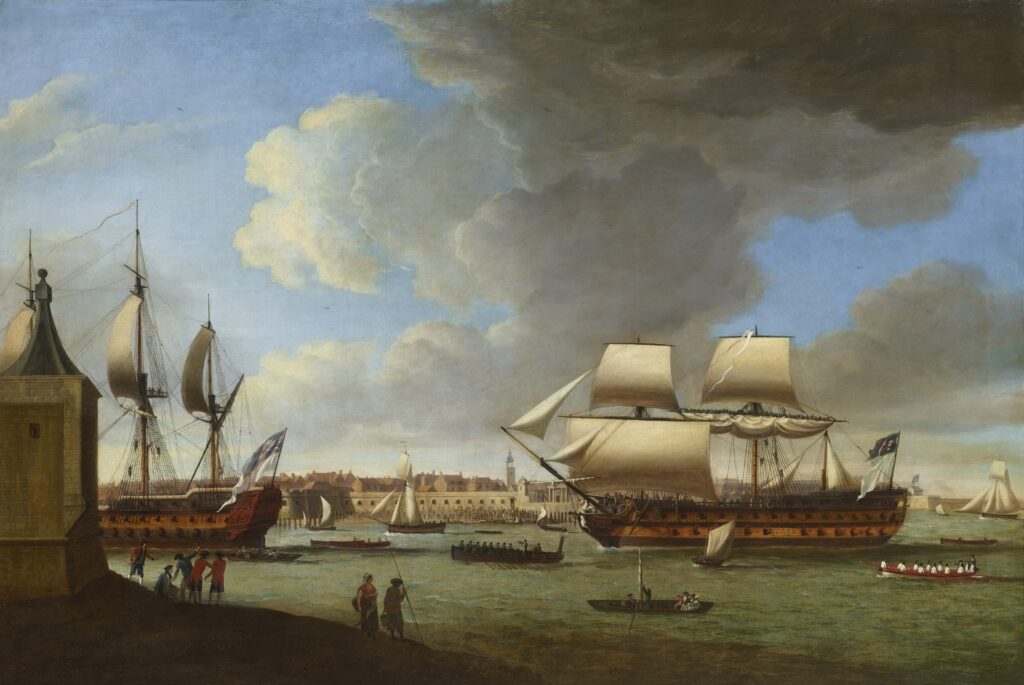
The Foudroyant, commanded by Sir John Jervis, bringing the Pégase into Portsmouth Harbour
Essay:
Dominic Serres was born in Auch in Gascony to modestly wealthy parents who envisioned a life in the priesthood for him. He was educated at a Benedictine seminary in Douai but ran away to become a sailor. Serres worked as a merchant sailor, was captured by the British in the Caribbean, and came to England as a prisoner of war in 1752. During his captivity in Marshalsea Prison he took up painting. His early works were evidently so successful that they gained him a number of commissions to paint country houses. Some of his earliest works are copies of Willem van de Velde I.
Serres made an important acquaintance in Charles Brooking, the leading shipping painter of the time, who gave him some formal training. He clearly excelled at this particular art form and was to specialize in marine painting for the remainder of his life. When the Royal Academy was founded in 1768 Serres became a founding member. He exhibited there regularly, becoming its librarian in 1792.
Such was his success as a painter that he was retained by George III as official naval artist to the Crown from 1780.
-
Presented in its fine original frame the present work was shown in the Royal Academy's 1793 exhibition as Nº 126, no doubt the prime version of this composition. A smaller version is in the collection of the Art Gallery of South Australia (acc. no. 876P16).
The event captured by Serres in this painting was a significant moment in English naval history of the 1780s and one of the crowning achievements in the career of John Jervis, later Earl of St Vincent. Jervis, captain of the Foudroyant, was in 1782 a rising star in the navy. The young captain was well acquainted with his ship having been its captain since 1775 and, by a happy coincidence, having been briefly first lieutenant of the French vessel after it had been captured in 1758 off Cartagena, Jervis sailing it home to England as a prize.
On the night of 19 April 1782 the eighty gun Foudroyant was part of vice-Admiral Barrington's squadron of 12 ships of the line lying off Brest. The squadron spotted a French convoy leaving the port. Upon seeing the British the French scattered and the Foudroyant made chase to the largest of the ships of war, the Pégase (74 gns). Around midnight and after several punishing broadsides Jervis succeeded in boarding and capturing the Pégase, the following day escorting her in to Portsmouth harbour.
Although there were only five English casualties in the skirmish (Jervis himself suffering a splinter wound) the French had eighty men killed and forty wounded, the Pégase losing both her mizen and foretopmasts. In honour of this daring victory Jervis was elevated to Knight of the Bath, his coat of arms referencing his victory by incorporating a winged horse. This was a tremendous success for the man who had run away from a career in law to join the navy as an able-seaman in 1748.
Serres has depicted the triumphal moment when the Pégase was led into Portsmouth to cheering crowds. Damage to the prize ship has for the most part been tactfully omitted. His second son, Dominique Michael, was at the time a volunteer able-seaman on the Foudroyant, (possibly as a result of a friendship between Serres and Jervis), and it is entirely likely that Serres himself was there to witness an event that would have had a very personal significance for him; he would have been able to make sketches of the occasion, and indeed the painting was completed just a few months later.
Jervis went on to great success in his career and was promoted Admiral in 1795. In 1797, commanding Victory, he positioned his fleet off Cape St Vincent in Portugal with the aim of preventing Spanish ships from joining forces with the French and Dutch further north and taking control of the Channel. He and his protégé, Commodore Horatio Nelson, distinguished themselves by overpowering 27 Spanish ships of the line and nine frigates at the ensuing Battle of Cape St Vincent, despite being outnumbered two-to-one by the enemy. In recognition Jervis was created Baron Jervis of Meaford and Earl of St Vincent, a title suggested by King George III, and became first lord of the Admiralty in 1801.
Provenance:
Sir John Jervis, Admiral of the Fleet and 1st Earl of St Vincent (1734-1823).
By descent to his nephew Edward Jervis, 2nd Viscount St Vincent (1767-1859).
Thence by direct descent in the Jervis family to the previous owners.
Literature:
A. Russett, Dominic Serres, R.A., 1719-1793; War Artist to the Navy, 1999, p.149, ill. pl.61 (the version in the collection of the Art Gallery of South Australia).
Exhibitions:
Royal Academy, 1793, London, no. 126, ('The Foudroyant, commanded by Sir John Jervis, bringing the Pegase, a French 74 into Portsmouth').