Giuseppe Bernardino Bison
1762 - 1844
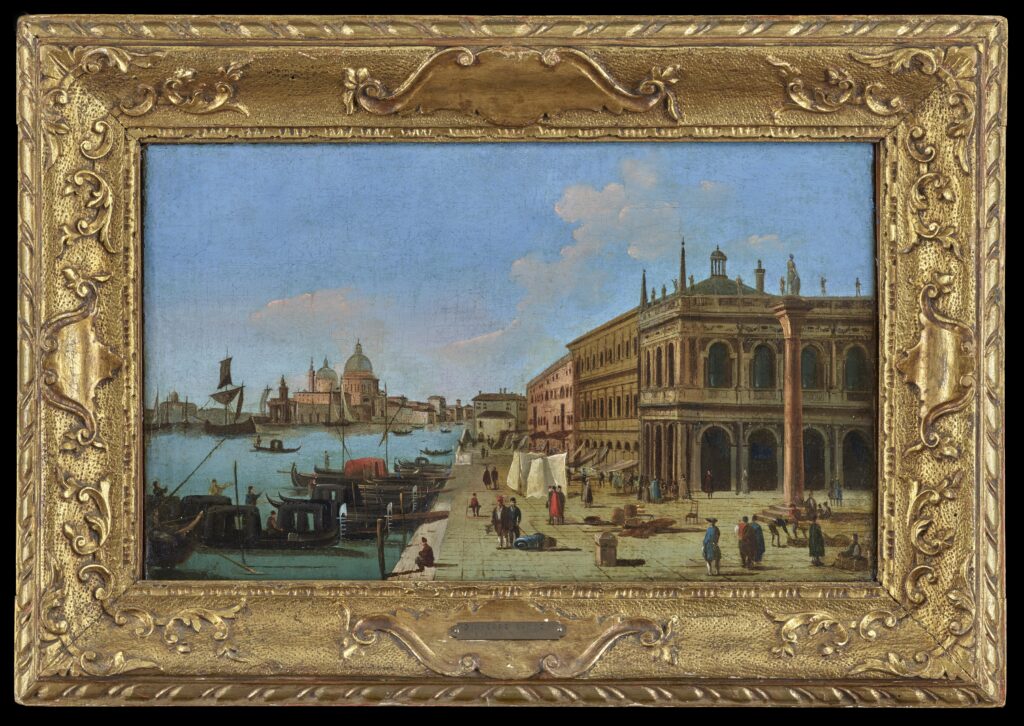
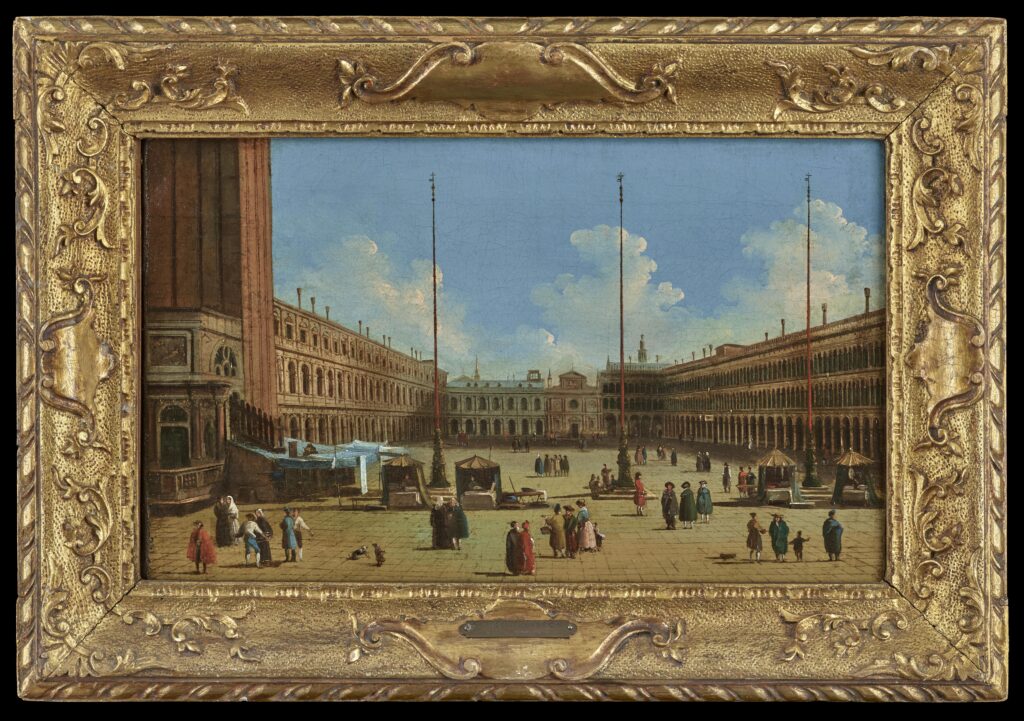
The Molo looking West towards the Dogana; and The Piazza San Marco looking West towards San Geminiano
Medium:
Oil on Canvas
Category:
Dimensions:
27(h) x 44(w) cms
Framed Dimensions:
40(h) x 59.5(w) cms
Essay:
A student of the Accademia di Pittura in Venice, Giuseppe Bernardino Bison was imbued with the 18th-century Venetian tradition, leading one scholar to describe his oeuvre as 'a last flowering of the Venetian Settecento' (G. Knox in J. Byam Shaw and G. Knox, The Robert Lehman Collection: Italian 18th Century drawings, New York, 1987, p. 18).
Born in Friuli, Bison's early career began where he trained as a painter in the studio of G. Romani and S. Gandini in Brescia and then as a pupil in the studio of Antonio Maria Zanetti the younger. He attended the Venice Accademia in 1779 to study drawing and perspective. A highly itinerant artist, from an early age he began to specialise in vedute views of the cities he stayed, but especially Venice, carrying on the tradition of the earlier masters such as Guardi, Bellotto and Canaletto. His views are always very precise in draughtsmanship and his attention to detail exquisite.
Bison was skilful painting frescos and worked on some religious works for Churches in Trieste, Ferrara and Treviso, and interestingly some theatre sets, owing to his friendship with the architect G.A. Selva. However, his work consists mostly of Venetian vedute and its surrounds.
-
In the view of the Molo, on the left in the distance is Santa Maria della Salute, on the right the column of Saint Theodore, and, next to it, the ornate Libreria. By the shadows cast over the Molo it appears to be late morning. The sail-like awnings are market stalls whose owners have put them up to protect them from the sun suggesting that it is already a hot day.
Bison's second view, the Piazza San Marco, is also looking west, though now the shadows have changed to suggest it is late afternoon or early evening. The Campinile di San Marco frames the left side of the picture while more market stalls, locals and visitors stroll around the piazza.
As one might expect this bustling scene has much in common with Canaletto's views. Indeed, Bison appears to have copied, with minor alterations, two of the plates from Antonio Visentini's engraved series after Canaletto paintings Urbis Venetiarum Prospectus Celebriores, numbers 12 and 11 respectively.
Provenance:
Anon. sale: Gallerie Weinmüller, Munich, 11 Dec. 1971, lot 1615.
Galerie Scheidwimmer, Munich 1972;
Private Collection, Munich;
Private Collection, Berlin;
Anon. sale: Galerie Bassenge, Berlin, 27 Nov. 2016, lot 6067;
Private collection, Northern Germany.