Willem van de Velde the younger
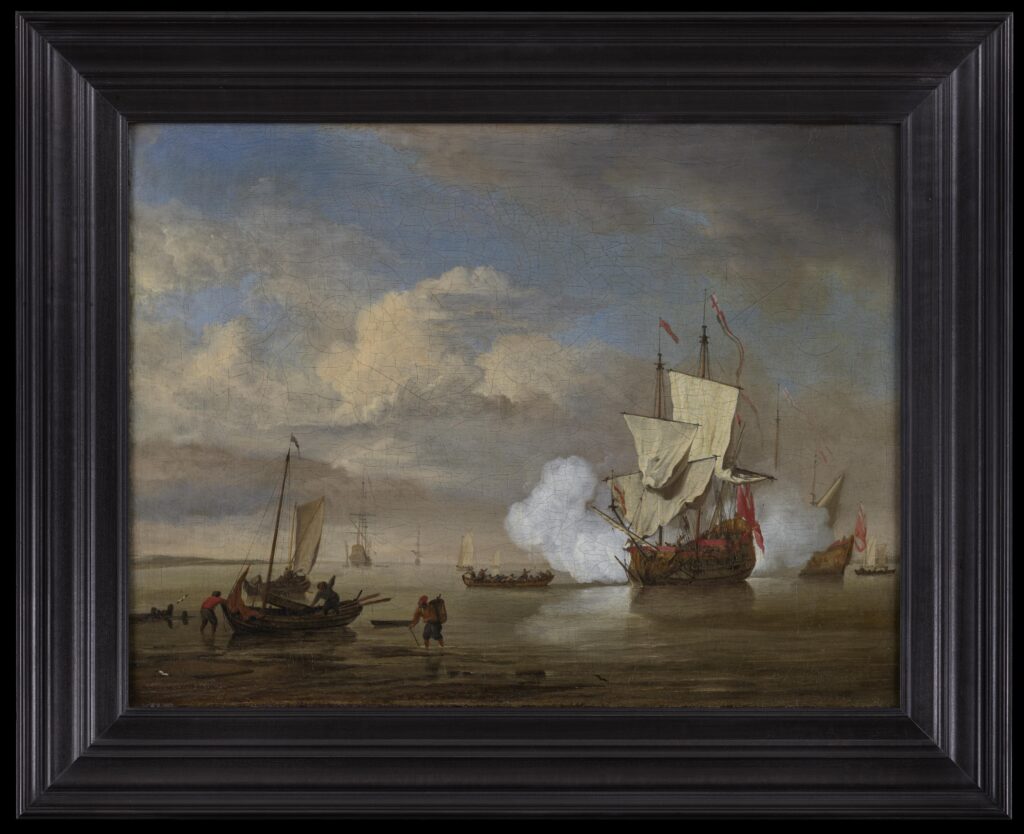
The Morning Gun
Medium:
Oil on Canvas
Category:
Dimensions:
38.8(h) x 51(w) cms
Framed Dimensions:
50(h) x 62(w) cms
Signed:
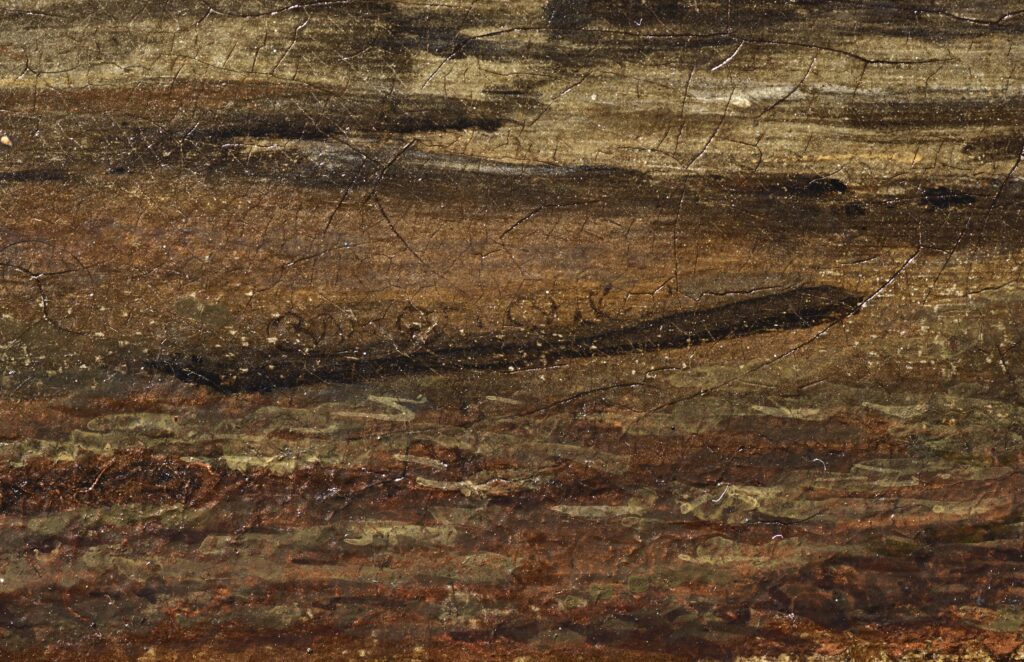
signed with initials on the driftwood lower left: W.V.V.J
Essay:
Willem van de Velde the Younger was probably the most important shipping painter of the Dutch school of the Seventeenth century. He was the son of Willem van de Velde the Elder and brother of Adriaen van de Velde.
At an early age he was apprenticed to Simon de Vlieger. He combined exceptional ability as a draughtsman with his master's expert handling of tones and light, though his own style tended more and more towards the use of colour. His skill in composition is of the first importance, involving the exact observation of the time of day, atmosphere, clouds, wind and waves, the set of a ship's sails and her position in the water. His figures are well drawn and though small at the beginning of his career, they later assume greater importance in the picture.
In 1672 or 1673 van de Velde went to England and together with his father produced large quantities of drawings and some paintings for the numerous commissions they received from the English nobility. Upon his father's death in 1693, Willem the Younger became the official Court marine painter to the King.
-
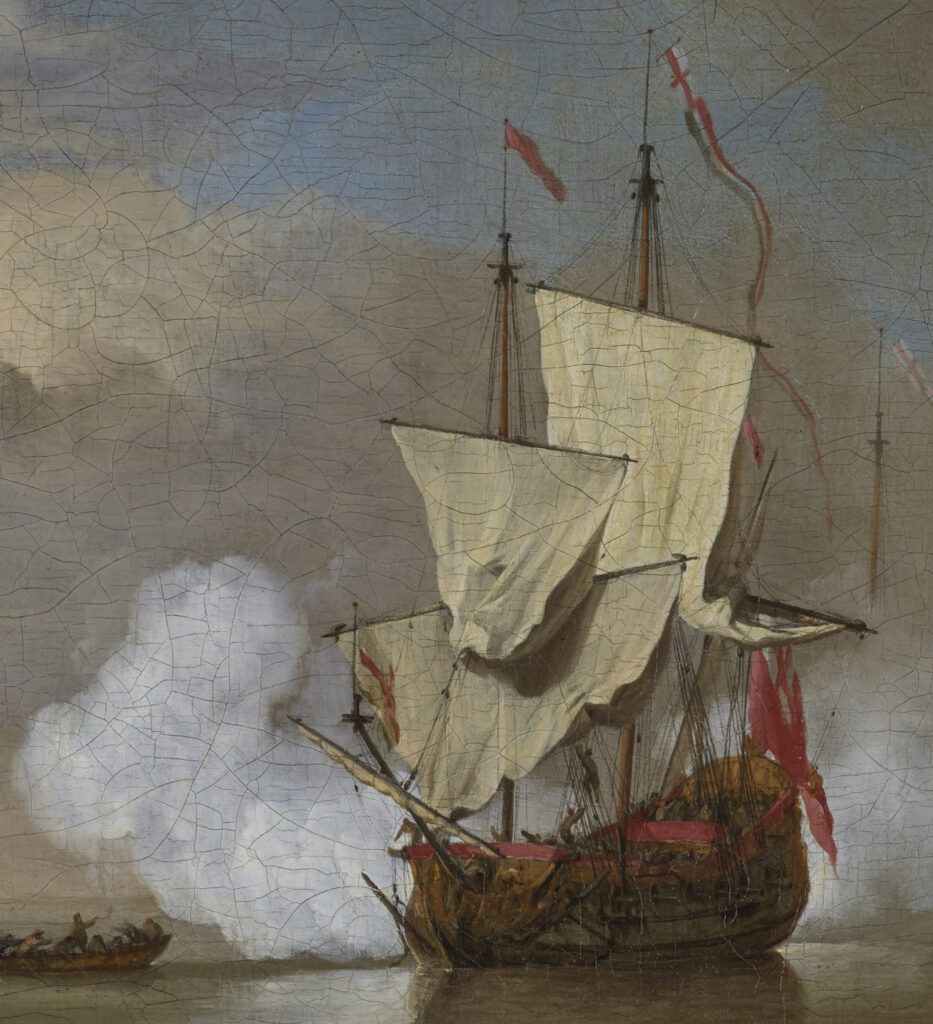
This morning coastal view is a newly discovered work from Willem van de Velde II's English period probably painted in the late 1680s. A single-decker English ship, probably a sixth-rated frigate, is seen on a port-bow view as it fires a salute starboard. In the left foreground two fishermen are pushing off from the shore in their pink near a wading figure with a basket. Other ships can be seen in the background and another frigate is obscured by smoke to the right. In the distance both left and right is land suggesting that the view is in an estuary.
The frigate is probably preparing to anchor and bustles with activity. The courses (fore and main sails) are half clewed up (the corners hauled in) to slow the vessel for manoeuvring and anchoring. The ship's barge at the centre rows away from the starboard bow, likely to fetch supplies or to land an important passenger. The starboard anchor is being attended to by a crewmember silhouetted against the smoke while a sailor standing on the beakhead tends to the port anchor. The frigate flies a long steaming common pendant from the main mast indicating that the ship is under Admiralty orders, a St George's flag from the bowsprit and a red ensign at the stern.
Van de Velde painted saluting ships in calm water frequently, but port bow views are quite rare while views of the stern of the ship are much more common. Two other saluting scenes of similar size dated c.1691 and c.1696 share very similar compositions with the present picture though the frigates are perhaps readying to depart their anchors (see M.S. Robinson, The Paintings of the Willem van de Veldes, Vol. II, no. 116 and no. 582, pp. 644-6). It is interesting to note that Robinson considers these two pictures to represent evening and afternoon respectively, while our own picture appears to be morning.
We are grateful to Dr Remmelt Daalder who has inspected the painting first-hand and believes it to be entirely by Willem van de Velde II. Dr Daalder has suggested that the picture was painted in the late 1680s.
Provenance:
Private Collection, UK.