Claes Jacobsz. van der Heck
c.1575/81 - after 1655
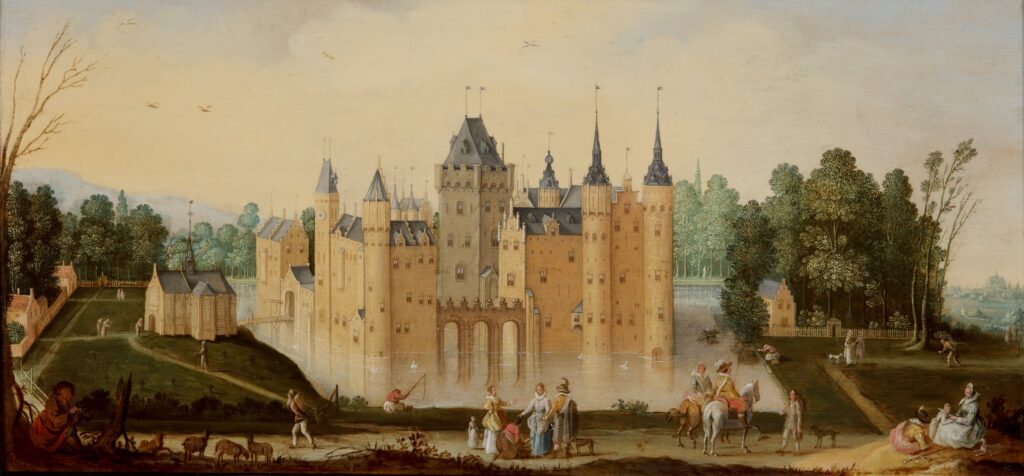
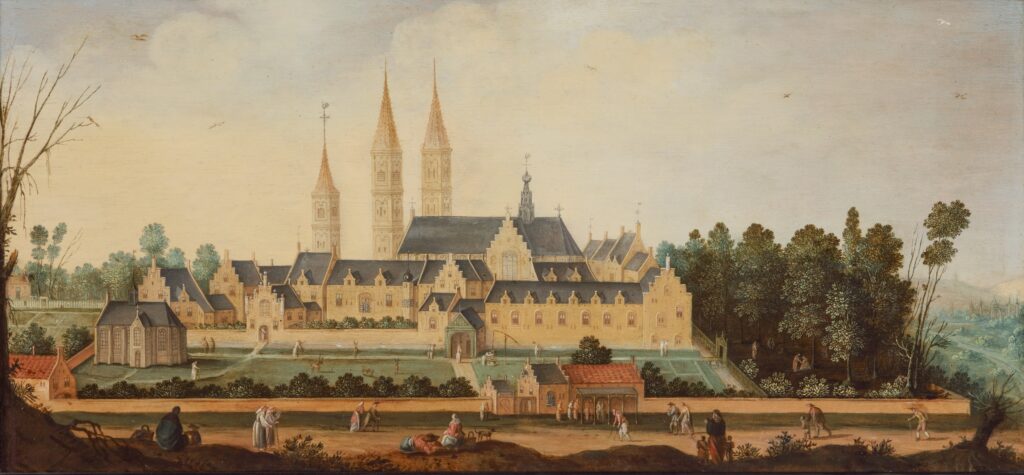
Views of Egmond Castle and Egmond Abbey, with elegant Figures in the Foreground and Peasants with their Sheep, a pair
Medium:
Oil on Panel
Category:
Dimensions:
27(h) x 57.5(w) cms
Signed:
signed and dated: 'Heck 1635'
Essay:
Claes Jacobsz van der Heck was the most important painter in Alkmaar in the first half of the 17th century, and one of the founders of the town’s Guild of St Luke in 1631. Based on his age, which is recorded variously in a number of archival documents, he was probably born in Alkmaar between 1575 and 1581. As Karel van Mander discusses in his Schilder-boeck of 1604, the actual year of Van der Heck’s birth is probably closer to 1575 than to 1581. Van Mander also mentions Van der Heck’s father, Jacob Dircksz van der Heck (c. 1534-1608), who was a nephew of Maarten van Heemskerck (1498-1574) and owned portraits by that famous 16th-century painter. Claes Jacobsz van der Heck married Cecilia Arts van Wede sometime before 1606, the year in which the couple’s eldest child was born.
According to Van Mander, Van der Heck trained with the little-known Haarlem landscape painter Jan Nagel. Van der Heck painted mountainous landscapes often with biblical or mythological staffage, as well as topographical views, and a rare witches sabbath picture in the Rijksmuseum, Amsterdam.
-
Claes Jacobsz van der Heck specialised in views of the Abbey of Egmond-Binnen and the Castle of Egmond aan den Hoef. In the painting of the abbey to the right Egmond Castle is shown in the distance, while a view of Alkmaar with the Sint Laurenskerk clearly recognisable, can be seen on the right of the painting of Egmond Castle.
There are several pendant views of the abbey and castle of Egmond, for instance those signed and dated 1638 in the Rijksmuseum, Amsterdam (object number SK-A-990 and 991); a pair dated 1655, sold at Sotheby's, Monaco, 19 June 1994, lot 412; and an undated pair sold at Christie's, Amsterdam, 14 May 2002, lot 131). The present pair dated 1635 is the earliest recorded pair.
Egmond Abbey was founded around 950 by Dirk I, Count of Holland, as a convent, but soon became a monastery for Benedictine monks. The abbey was the oldest in the Netherlands and was an important cultural centre in the Middle Ages, possessing a very large library. Egmond Castle was the seat of the counts of Egmond.
Under orders of William the Silent both the abbey and castle were destroyed by the troops of Diederik Sonoy, governor of the northern quarter of Holland in 1573, in order to prevent invading Spanish troops from using them as encampments. Both structures were in ruins in Van der Heck’s time, so he obviously based his views of them on earlier images made before they were destroyed.
A painting by Gilles de Saen (ca. 1580-1610) now in the townhall of Zottegem, Belgium probably served as the prototype for Van der Heck’s view of Egmond Castle. For the Abbey he possibly used an early edition of a print which was published in Alkmaar in 1630.
Provenance:
Dutch private collection since the 19th Century.