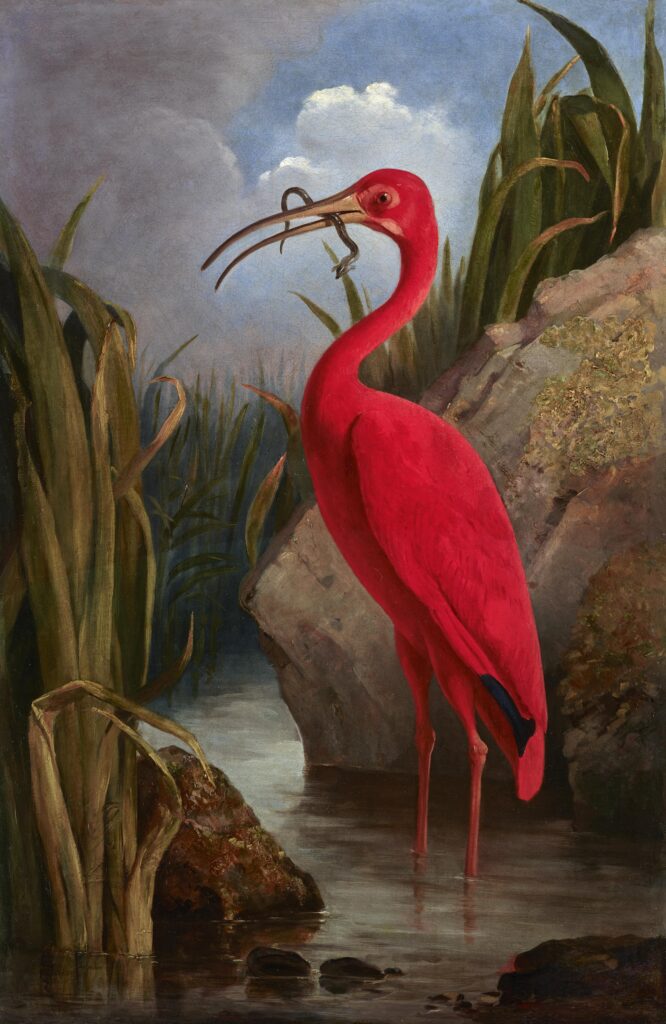
Philip Reinagle
1749 - 1833
A Scarlet Ibis (Eudocimus Ruber) standing in a Stream, an Eel in its Beak
Exhibitions:
Essay:
Reinagle’s parents emigrated to Scotland from Hungary as part of the Young Pretender movement just four years before he was born. At the age of fourteen, Reinagle studied art in Edinburgh under the eminent portrait painter Allan Ramsey, after whom his son Ramsey Richard Reinagle (1775-1862) was later named. Reinagle then served as an assistant to Allan Ramsey in the latter’s studio for the repetition of royal portraits. Although he began his career as a portrait painter, he became famous for painting almost all subject matters with a high and equal level of competence. His paintings include portraits, animals, sporting scenes, still lifes and landscapes, which he painted in the style of the Dutch masters. If one had to choose a subject at which he particularly excelled it would have to be his birds which are energetic with beautiful skies above.
Reinagle was extremely prolific as well, exhibiting over 150 paintings, mostly at the Royal Academy and the British Institute. Some titles include A Representation of Mister Money’s Situation when He Fell into the Sea with a Balloon, A Peregrine Hawk upon a Woodcock, A View in the Bay of Sarza Near Genoa, A Spanish Pointer, and Moor Shooting. His son Ramsey Richard became an even more productive painter and exhibited over 300 paintings at the same prestigious venues. Reinagle’s two daughters, Fanny and Charlotte, also exhibited at the Royal Academy and the British Institute. All told, Reinagle was the patriarch of a family of twelve artists.
Reinagle moved to London in 1769 and married Jane Austin (not the writer) on 24 July, 1771. He died in Chelsea on 17th November, 1833. Examples of his work are in the Victoria and Albert Museum, the Wolverhampton Gallery and in the Diploma Gallery of the Royal Academy.
-
The scarlet ibis is a wading bird native to tropical South America and the Caribbean. The bird would have been an exotic novelty to Europeans when they first saw it as its remarkable red plumage is quite unlike the black and white ibises known to Egypt. Reinagle likely imagined the scenery surrounding the bird, but he must have been reliably informed about the behaviour of the ibis as small snakes are a part of its diet. The scenery does bare some resemblance to European wetlands seen in a handful of other paintings by Reinagle, so it is perhaps possible he saw it adorning the grounds of a wealthy patron.
Provenance:
Private collection, Ireland.