Hendrick van Steenwyck II
1580 – 1649
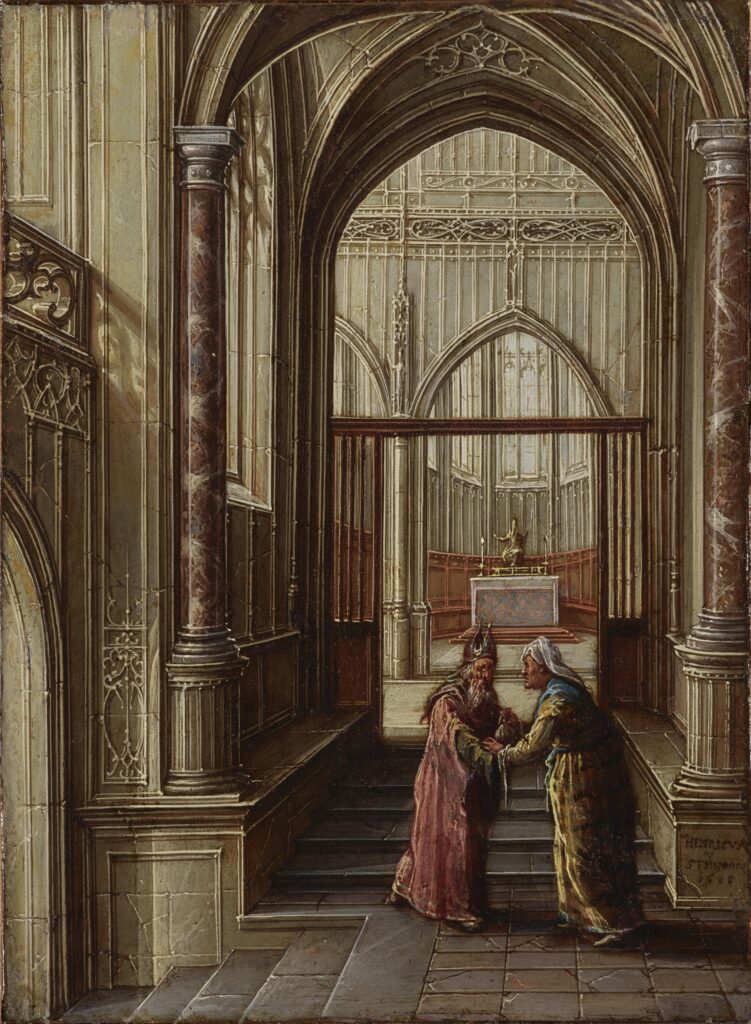
A Temple Interior, perhaps showing the story of Esther and Mordecai
Medium:
Oil on Copper
Category:
Dimensions:
13.3(h) x 9.5(w) cms
Signed:
Signed and dated on the column lower right: 'HENDRICVS / V / STEINWYCK / 1608'
Essay:
Hendrick van Steenwyck the Younger was a Flemish painter of architecture who chiefly painted church and dungeon interiors in the style of his father, Hendrick van Steenwyck the Elder, whose pupil he was. It is presumed he lived in Antwerp, although he is never mentioned as a member of the guild. After his father's death in 1617, Steenwyck pursued a flourishing and prolific career in England. He had left London by about 1640, having returned to the northern Netherlands and to his wife Susanna, also a painter, who in later documents is referred to as a widow living in Leiden.
While at King Charles I's court, Steenwyck occasionally worked with van Dyck and executed the background perspectives in a number of his portraits. His style was meticulous and crisp with very careful attention to detail, more so than his father. He used a lower horizon giving less of a sense of space in his pictures, but nevertheless his works show an acute grasp of perspective. His colours are sometimes bright, although a prevailing tone of grey-yellow is more common. He worked with a great many painters as well as van Dyck, notably Jan Brueghel I, Frans Francken I and II and Daniel Mytens.
-
This picture appears to show a woman offering a purse to a priest in an impressive gothic interior. The picture is similar to six other works dated in the 1610s and 20s showing secretive meetings between a woman and a priest. Jeremy Howarth suggests that the scenes are not part of a Christian story. Pagan imagery by Steenwyck from around this period was not uncommon and several works depict the story of the priests of Baal while others show mysterious nocturnal feasts.
Howarth has suggested that the interiors with scenes close to the present picture are not set in churches, but instead show imaginary gothic-style pagan temples with pagan statues on the altars. He suggests these scenes might depict the meeting between Esther and Mordecai and points out in particular a nocturnal scene today in the National Gallery of Art, Washington (see J. Howarth, The Steenwyck Family as Masters of Perspective, 2009, Turnhout, Belgium, II. E 20, p. 258, illus. p. 537).
Esther was the wife of Ahasuerus, the King of Persia, and had a meeting with her uncle Mordecai at the gate of the palace to obtain advice from him. The Book of Esther describes two meetings. The first, when Mordecai warned Esther that he had discovered a plot by two eunuchs to kill the King. The second meeting is when Mordecai informs Esther of the plan of Haman (a royal favourite) to massacre all of the Jews in the Kingdom and begs her to use her influence with the King to avert the tragedy which she duly does.
However, the connection of to the story of Esther and Mordecai story is not entirely convincing. Firstly, the woman appears to be elderly while Esther is typically depicted as being young and beautiful. Secondly, though money does feature in the story it does not change hands between Esther and Mordecai. The painting may have a more ambiguous message, perhaps one of charity.
A nearly identical version to the present picture is painted on panel and is dated 1640 (see J. Howarth, op. cit., II. B 46, p. 160, illus. p. 447).
Provenance:
Private collection, USA.